

There’s a quiet kind of grief that parents carry when their 20-year-old is spiraling.
You’ve done the hard things: therapy, boundaries, late-night talks, consequences. You’ve loved them as fiercely as you can. And still… they’re using again. Or isolating. Or lying. Or not showing up to life.
Now home feels like a battleground. And you’re tired.
It’s not weakness to want help. It’s wisdom. When the emotional weight becomes unmanageable, a partial hospitalization program can provide the structure your child needs—and the support you need to breathe.
What Is a Partial Hospitalization Program (PHP)?
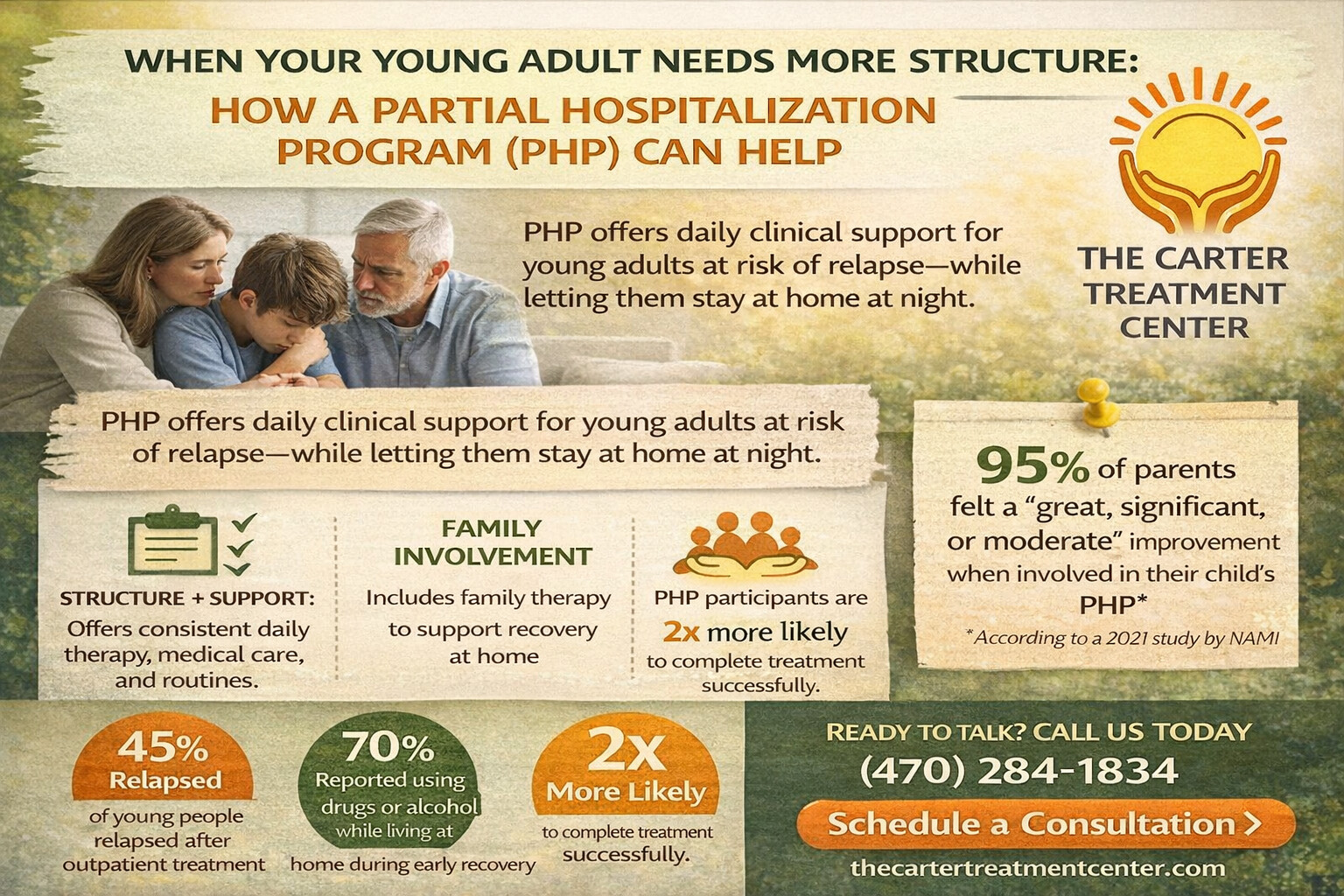
A partial hospitalization program is one of the most intensive forms of outpatient treatment. It offers structured, clinical care for several hours each day (typically 5–6 hours), 5 days a week. Clients return home or to supportive housing in the evenings, giving them the chance to practice life skills in the real world—while staying rooted in daily support.
Think of it as a middle path: more intensive than weekly therapy, but not as restrictive as residential treatment.
At The Carter Treatment Center, our PHP includes:
- Daily group therapy sessions rooted in evidence-based practices
- Individual therapy multiple times per week
- Medication management with licensed medical providers
- Family therapy to support connection and boundary healing
- Peer support, education, and relapse prevention strategies
This model is ideal for young adults who are in emotional distress, at risk of relapse, or stepping down from inpatient care—but who still need structure to stabilize.
Why Home Alone Isn’t Enough (And That Doesn’t Mean You Failed)
Let’s name it: parenting a young adult in crisis is emotionally brutal. Especially when you’ve tried everything, and nothing sticks.
Eventually, you start to live in survival mode:
- You track their moods like weather patterns.
- You hide your worry under work and routine.
- You vacillate between hope and heartbreak.
Home becomes a place of fear, not rest.
But here’s the truth: homes aren’t meant to function like treatment centers. They’re meant to be homes.
When your child needs daily clinical care, it’s okay—wise, even—to let professionals take the reins for a while.
A PHP doesn’t replace your role as a parent. It releases you from playing roles you were never meant to carry alone.
What Structure in PHP Actually Looks Like
It’s not just about keeping them busy—it’s about giving their nervous system, brain, and spirit a chance to stabilize.
Here’s what structure in PHP does:
- Establishes a predictable routine that reduces chaos and reactivity
- Provides healthy peer connection to replace isolating or risky relationships
- Offers clinical consistency, so they’re not starting from scratch every week
- Gives space for emotional accountability, without family dynamics clouding the process
- Includes family therapy, because healing doesn’t happen in isolation
Your child will know what each day holds. They’ll be met with boundaries, empathy, and real-time support. And you’ll know they’re somewhere safe, getting help that’s actually calibrated to the level of their struggle.
What Parents Often Feel (And Why It Makes Sense)
Many parents describe a complex emotional swirl when their child enters PHP:
“I feel like I should’ve been able to fix this.”
“What if they hate me for pushing treatment again?”
“I feel relief, but also guilt for that relief.”
Let’s be clear: those feelings are normal.
Grief. Hope. Guilt. Numbness. All valid.
What we remind families every day is this: love doesn’t mean doing it all yourself. Love means getting your child the help they need.
And structure? Structure is one of the deepest forms of love there is—especially for a young adult whose life feels unmanageable.
When to Consider a Partial Hospitalization Program
If you’re reading this, chances are your gut already knows the answer.
But here are some signs that PHP may be the right fit:
- Their mental health or substance use is interfering with daily life—but not requiring 24/7 care
- You’ve tried weekly therapy, but it’s not enough
- They’ve been discharged from residential or inpatient care and need continued structure
- You’re seeing escalating issues at home: anger, withdrawal, self-harm, lying, chaos
- You’re afraid to leave them alone—or afraid of what will happen if you don’t set a boundary
You don’t have to wait for a rock bottom. PHP is a proactive step, not a punitive one.
Why Young Adults Respond to PHP Differently Than Teens
It’s important to note: young adults aren’t just older teens. They’re in a developmental gray zone—legally adults, but often still reliant on family for housing, finances, or emotional support.
That’s why PHP works well for this group:
- It respects their autonomy
- It includes them in their own care plan
- It introduces responsibility within structure
- It avoids the “lockdown” feeling of inpatient treatment
They’re treated like the young adults they are—not like children, not like criminals.
How PHP Supports the Whole Family
At The Carter Treatment Center, we don’t just treat the client. We support the entire family system.
Here’s how:
- Family therapy sessions to work through conflict, guilt, and communication blocks
- Psychoeducation to help parents understand addiction, trauma, and mental health
- Support planning so you’re not left wondering what happens next
And when you’re ready, we help you shift from “rescuer” to “supporter”—a transition many parents need help navigating.
If you’re looking for community-based support in metro Atlanta, our team is here to walk with you, not just your child.
FAQs About Partial Hospitalization Programs
What’s the difference between PHP and inpatient treatment?
Inpatient treatment requires overnight stays and 24/7 monitoring. PHP offers many of the same therapies and intensity of care, but allows clients to return home or to a sober living environment in the evenings.
How long does a PHP program last?
Most PHPs last 2–4 weeks, but can vary depending on individual needs. At The Carter Treatment Center, we work closely with each client to determine the appropriate length of stay based on progress and clinical recommendation.
Can someone work or go to school during PHP?
Because PHP is a daytime commitment, full-time work or school usually isn’t feasible during the program. However, the structure of PHP prepares clients for a smoother return to those responsibilities when ready.
Is PHP covered by insurance?
Yes, many insurance plans cover partial hospitalization programs. Our team can help verify your benefits and explain your options clearly—no surprise bills or confusing jargon.
What happens after PHP?
After PHP, clients may step down into an intensive outpatient program (IOP) or traditional outpatient therapy. This “continuum of care” approach helps ensure they’re supported at every stage of recovery.
You Don’t Have to Hold This Alone
Parenting a struggling young adult can feel like trying to build a house during an earthquake.
A partial hospitalization program won’t erase the pain—but it will give your child (and you) solid ground to stand on.
📞 Ready to Talk?
Call (470) 284-1834 or visit to learn more about our partial hospitalization program services in Alpharetta, GA.
Let this be the moment you let someone else carry part of the load. Not because you’re weak—but because love is stronger when it’s shared.