


Some people imagine treatment as stepping away from everything — work, family, responsibilities, and routines.
But many of the people who walk through our doors never stopped showing up to those things in the first place.
They’re professionals, parents, business owners, caregivers, and partners. Their lives are full. Their calendars are full. And on the surface, everything looks stable.
Yet behind that stability, there’s often a different story quietly unfolding.
For many people exploring a multi-day weekly treatment program, the realization isn’t that life has collapsed. It’s that holding everything together has become exhausting.
And that kind of exhaustion doesn’t always show up where people expect.
When Everything Looks Fine — But Doesn’t Feel Fine
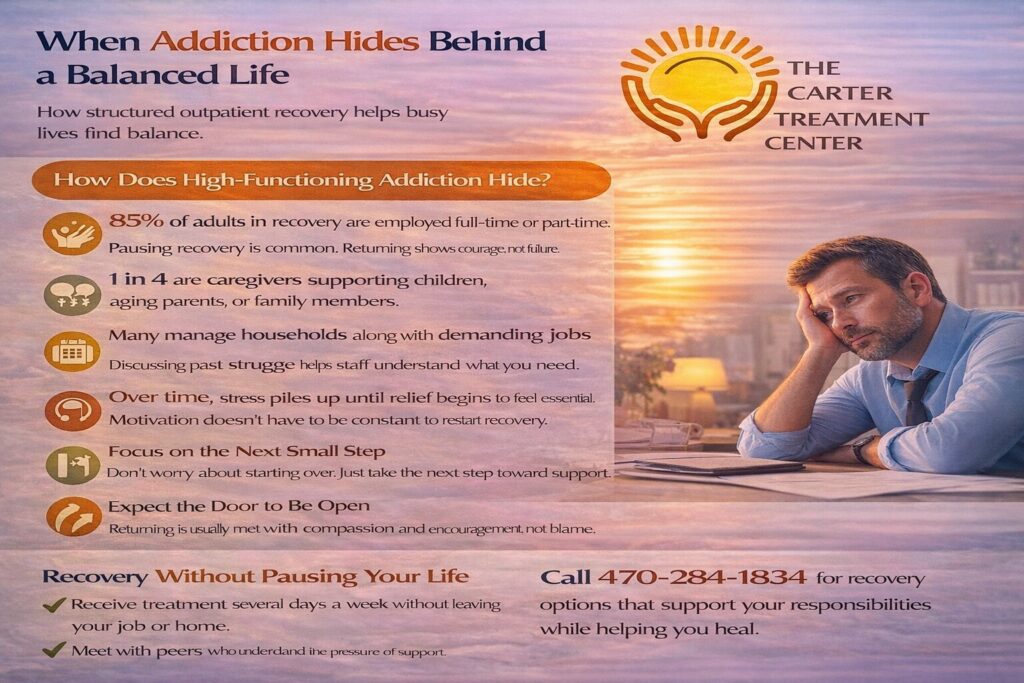
High-functioning substance use often hides in plain sight.
The people experiencing it aren’t missing responsibilities. In fact, they’re often the ones carrying the most.
They lead meetings.
They manage households.
They volunteer, provide, and take care of others.
From the outside, their lives appear balanced.
Inside, things can feel very different.
The day might start with good intentions — productivity, focus, control. But by the afternoon, the pressure builds.
Stress piles up.
The mental noise gets louder.
And the thought creeps in: I just need something to take the edge off.
Over time, that relief starts to feel less like a choice and more like a requirement.
Not to feel good.
Just to feel normal.
The Hidden Cost of “Keeping It Together”
One of the most difficult parts of high-functioning addiction is the invisibility of it.
Because responsibilities are still being met, it becomes easy to dismiss the problem.
You might hear thoughts like:
- I’m still doing my job.
- My family doesn’t know.
- Other people have it worse.
But internally, many people feel something different entirely.
There’s a constant background tension — the sense that you’re balancing two lives at once.
One life is the version everyone sees.
The other is the private negotiation happening every day:
How much is too much?
Can I skip tonight?
What happens if someone notices?
Living that double life requires energy.
And eventually, the exhaustion catches up.
The Quiet Moment People Start Looking for Help
Contrary to what movies or headlines suggest, the turning point for many people isn’t a dramatic crisis.
It’s often a quiet moment.
Maybe it happens after a long day when the house is finally quiet.
Maybe it’s after a conversation you barely remember having the night before.
Maybe it’s noticing your patience with your kids or partner slipping more often.
Sometimes people describe it like this:
“Nothing was falling apart. But I realized I couldn’t keep doing this forever.”
That realization — quiet, honest, and deeply personal — is where many people begin exploring recovery options.
Not because they’ve hit a stereotypical “rock bottom,” but because they’re tired of living in constant tension.
What Support Can Look Like When Life Doesn’t Stop
One of the biggest fears people have when considering treatment is the idea that they’ll have to disappear from their lives completely.
For someone with a career, family responsibilities, or community commitments, that thought alone can feel overwhelming.
Fortunately, recovery support doesn’t always require stepping away from everything.
Programs designed for people with active responsibilities allow individuals to receive consistent care several days a week while continuing to live at home and maintain their daily roles.
Many people entering an intensive outpatient program find that it creates something they didn’t realize they were missing: structured space to work on themselves.
They still go to work.
They still show up for family life.
But a few days each week, they step into an environment where honesty replaces performance.
What a Typical Week Can Feel Like
People often expect treatment to feel clinical, rigid, or intimidating.
Instead, many describe it as grounding.
A typical week might include several structured sessions where individuals:
- Meet with therapists to understand the emotional patterns driving substance use
- Participate in group discussions with others navigating similar pressures
- Learn practical strategies for stress, boundaries, and healthier coping
- Rebuild routines that support long-term stability
These sessions become anchor points in the week.
Instead of white-knuckling through stress until the next drink or substance, people start developing tools that actually help them manage their lives more clearly.
Over time, the rhythm becomes something people rely on rather than something they fear.
The Unexpected Relief of Being Honest
For high-functioning individuals, one of the most powerful parts of recovery is something simple: honesty.
Many people who appear successful externally are carrying immense internal pressure.
They’re used to being the capable one.
The reliable one.
The person who handles everything.
In recovery spaces, that pressure drops.
They can say things they’ve never said out loud before:
- “I’m overwhelmed.”
- “I don’t know how to stop.”
- “I’m scared people will find out.”
And instead of shock or judgment, they often hear recognition.
Other people in the room understand exactly what they mean.
That shared understanding can feel like the first real exhale someone has taken in years.
How Recovery Strengthens the Life You Already Have
A common misconception is that recovery means giving something up.
In reality, many people discover the opposite.
They begin regaining parts of their life that had slowly been slipping away.
They sleep better.
They think more clearly.
They feel more present in conversations and relationships.
One client once said:
“I thought treatment meant my life would get smaller. It actually made it bigger.”
Parents reconnect with their kids.
Professionals regain focus and creativity.
Relationships regain honesty.
Recovery doesn’t erase responsibilities.
It simply makes them feel manageable again.
Success Stories Often Look Quiet
The success stories we see most often don’t involve dramatic transformations.
They’re quieter and more personal.
A mother who says evenings no longer feel like survival mode.
A business owner who notices they’re more patient with their team.
A parent who remembers every detail of their child’s school event instead of half of it.
These moments might seem small from the outside.
But to the person living them, they represent a massive shift.
They represent peace.
Finding Support Without Losing Your Life
If you’re someone who still shows up every day — to work, to family, to responsibilities — but privately feels worn down, you’re not alone.
Many people in similar situations have found real change through structured recovery support that fits around their lives.
For those seeking compassionate care and practical guidance, there are options for recovery and support in metro atlanta through programs designed for people balancing work, family, and healing.
You don’t have to wait until things fall apart to explore something better.
Sometimes the bravest step is simply admitting you’re tired of carrying everything alone.
Frequently Asked Questions
Can someone attend treatment while still working full-time?
Yes. Many recovery programs are designed specifically for people who maintain jobs and responsibilities. Sessions are often scheduled during evenings or flexible daytime hours so participants can continue working while receiving support.
Will my family know I’m attending treatment?
Confidentiality is a central part of behavioral health care. While some people choose to involve loved ones in their recovery process, the decision is ultimately up to the individual.
What if I’m not sure my substance use is “serious enough”?
Many high-functioning individuals struggle with this question. The truth is that seeking help isn’t about meeting a specific threshold — it’s about improving your well-being and addressing patterns that no longer feel sustainable.
How long do people usually stay in structured outpatient care?
Length of care varies depending on individual needs and progress. Some people participate for several weeks, while others continue longer to strengthen stability and build stronger coping skills.
What happens during group sessions?
Group sessions provide a space for people to talk openly about challenges, share experiences, and learn from one another. Many people find group discussions especially helpful because they realize they’re not the only ones navigating these struggles.
Is it possible to recover without leaving my normal life behind?
Yes. Many people successfully rebuild their relationship with substances while continuing to live at home, maintain employment, and stay connected to their families.
Recovery doesn’t require your life to fall apart first. Sometimes it begins the moment you admit you’re tired of holding everything together. Continued recovery support is available for those seeking care in Alpharetta, GA and Jefferson, GA.
Call 470-284-1834 or explore our intensive outpatient program services to learn more about our intensive outpatient program services.