


You’ve already crossed a quiet but powerful line—you know something needs to change. That awareness alone takes courage. What comes next can feel unclear, even overwhelming. If you’re considering a structured daytime care option, it helps to hear what the experience is actually like from a human perspective—not just a clinical one.
This isn’t about getting everything right. It’s about beginning.
It’s Not as Overwhelming as Your Mind Might Be Telling You
Before starting, a lot of people imagine something intense, rigid, or emotionally exhausting every single moment.
The truth is more balanced than that.
Yes, there are real conversations. Yes, you’ll be asked to look at things honestly. But it’s not constant pressure. There are pauses, lighter moments, even laughter sometimes.
You’re not walking into a place where you’re expected to unravel all at once. You’re stepping into a space where things unfold gradually.
And that difference matters.
You Don’t Have to Be “Ready Enough” to Begin
There’s often this invisible threshold people think they need to cross before starting treatment.
“I need to feel more certain.”
“I need to want this more.”
“I need to have my story figured out.”
You don’t.
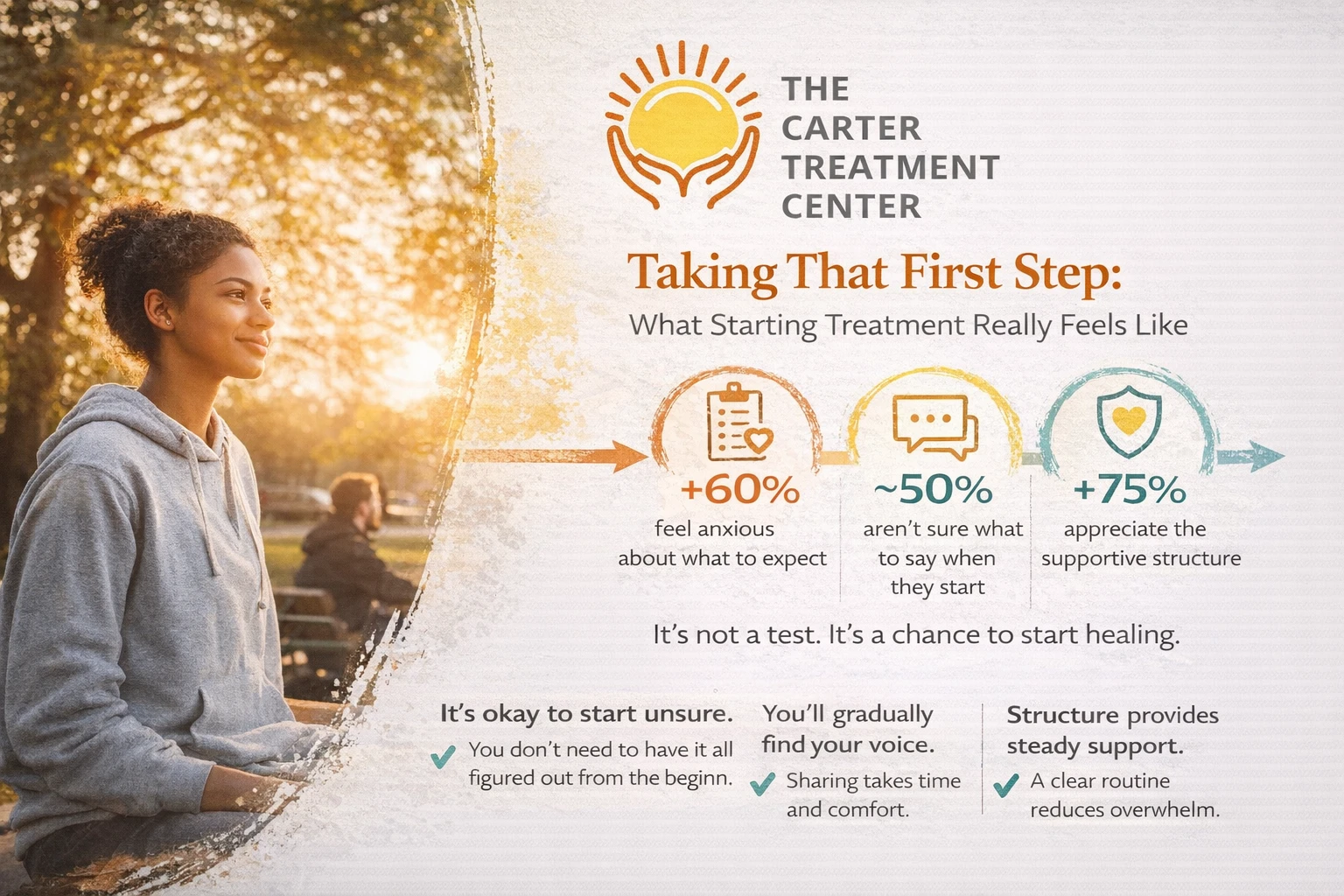
You can walk in unsure. You can feel resistant. You can even question whether this will work.
None of that disqualifies you.
In fact, most people start exactly there.
The Structure Might Feel Strange—But It’s There to Hold You
Having your day planned out can feel unfamiliar at first.
There are set times for group sessions, individual support, and breaks. It’s different from the unpredictability you may be used to.
But here’s what people often realize after a few days:
Structure doesn’t trap you—it steadies you.
When your thoughts feel scattered or heavy, having a rhythm to your day can feel like something solid to lean on. You don’t have to constantly decide what’s next. You just move through it.
Step by step. Hour by hour.
You’ll Hear Yourself in Other People’s Stories
One of the most unexpected parts of treatment is how often you recognize pieces of yourself in someone else.
Not identical lives. Not the same details.
But the same feelings.
The same confusion. The same coping patterns. The same quiet fears.
And when that happens, something shifts.
You stop feeling like the only one carrying this.
There’s a kind of relief in realizing you’re not uniquely broken—you’re human, and you’re in a room full of people trying to heal too.
Progress Can Feel Messy Before It Feels Real
There’s a common expectation that once you start treatment, things will begin improving in a straight line.
That’s rarely how it works.
Some days will feel clear and hopeful. Other days might feel heavier than before you started. You might leave feeling emotionally stirred up, or even tired in a way that’s hard to explain.
That doesn’t mean something is wrong.
It often means something is shifting.
Growth can feel like discomfort before it feels like relief. Like stretching something that’s been tight for a long time.
You Still Get to Be a Person Outside of Treatment
This level of care doesn’t remove you from your life entirely.
You still go home. You still have your environment, your routines, your responsibilities.
And that can feel both comforting and challenging.
You’re learning new ways to cope while still living your real life. Not in isolation, but in motion.
For many people, that makes the process feel more grounded. More realistic. More sustainable.
You Might Be Surprised by What You Actually Learn
It’s not just about talking.
It’s about understanding patterns—how your thoughts, emotions, and behaviors connect. It’s about learning how to pause instead of react. How to sit with discomfort instead of escaping it.
Some of the most meaningful changes are quiet ones:
- Catching yourself before a spiral
- Saying something honest instead of avoiding it
- Noticing a feeling instead of numbing it
These aren’t dramatic moments. But they add up.
Fear Doesn’t Mean You’re Not Ready
Almost everyone feels afraid before starting.
Not just nervous—afraid.
Afraid of failing.
Afraid of change.
Afraid of what they might have to face.
And sometimes, even afraid of what life might look like if things actually get better.
Fear doesn’t mean stop.
It just means you’re standing at the edge of something unfamiliar.
You don’t have to eliminate fear to move forward. You just have to move with it.
You’re Allowed to Take This One Day at a Time
There’s pressure—internal or external—to “fix everything” quickly.
But that’s not how this works.
You’re not expected to solve your entire life in a week.
You just show up today.
Then tomorrow.
And eventually, those days begin to connect.
You’re Not Starting Over—You’re Starting From Experience
It might feel like you’re behind. Like you should have figured this out already.
But you’re not starting from zero.
Everything you’ve lived through—every attempt, every realization, every moment of awareness—comes with you.
That’s not failure. That’s context.
And it matters more than you think.
Support Can Look Different Than You Expected
Sometimes people expect treatment to feel clinical or distant.
But what many find instead is something more human.
Real conversations. Real reactions. Real care.
Not perfect. Not scripted.
Just people meeting you where you are, without requiring you to pretend.
Finding Care That Feels Close to Home
For some, location matters more than they expected.
Being able to access support without completely disconnecting from your life can make starting feel more possible.
If you’re looking for options nearby, there are ways to find care that feels both accessible and supportive, including services available in Alpharetta, Georgia.
You don’t have to go far to begin.
FAQ: What People Often Wonder Before Starting
Will I have to share everything right away?
No. You can move at your own pace. Sharing is encouraged, but never forced. Trust builds over time.
What if I don’t connect with the group?
That happens sometimes at first. Give it a little time. Most people find at least one person or moment that helps them feel less alone.
Can I still manage my responsibilities outside of treatment?
Yes. This level of care is designed to fit into your life while giving you meaningful support during the day.
What if I’ve tried treatment before?
That experience still matters. This doesn’t have to be the same as what you tried before. Different environments and approaches can feel very different.
How do I know if this is the right step?
If you’re asking the question, it’s worth exploring. You don’t have to commit to everything—you just have to be open to learning more.
What if I feel worse before I feel better?
That can happen. Processing emotions can bring things to the surface. It’s a normal part of growth, and you won’t be left to handle it alone.
Will people judge me?
Most people are too focused on their own healing to judge anyone else. The environment is built to be respectful and supportive.
You Don’t Have to Have It All Figured Out
There’s no perfect mindset required to begin.
You don’t need certainty. You don’t need confidence. You don’t even need to believe this will work.
You just need a small willingness to see what might be possible.
That’s enough.
Call (404) 689-9980 or visit our partial hospitalization program in Metro Atlanta to learn more.