


You can feel it in your chest before you can explain it in words.
Something isn’t right. Maybe they’re still going to work or school. Maybe they still show up just enough to make it look okay from the outside. But you’ve watched the subtle shifts—the mood changes, the distance, the way conversations don’t land the same anymore.
And every time you try to talk about help, you hit the same wall.
“I’m fine.”
“I don’t need that.”
If you’re here, you’re likely standing in that painful space between knowing your child needs support and not knowing how to guide them toward it. Exploring a structured daytime care option can sometimes offer a middle path—one that doesn’t feel like forcing, but also doesn’t leave things as they are.
Denial Isn’t Defiance—It’s Protection
From a clinical standpoint, denial is rarely about rebellion.
It’s about self-preservation.
Your child may not be ready to fully see what’s happening because acknowledging it would bring a flood of emotions—shame, fear, guilt, or even a sense of failure. That’s a heavy weight for anyone, especially a young adult still figuring out who they are.
So instead, they minimize. They deflect. They insist they’re okay.
And as a parent, that can feel unbearable. Because you’re watching something unfold in real time, and they’re not seeing it the same way.
But here’s the shift that matters:
Denial doesn’t mean they don’t need help. It means they’re not ready to face it all at once.
Why Pushing Harder Often Makes Them Pull Away
It’s instinct to try to fix this.
To explain. To convince. To lay out all the reasons they need help.
But the more pressure they feel, the more likely they are to shut down or push back.
Not because they don’t care—but because it feels like losing control.
Young adults, especially, are navigating independence. The moment help feels like something being done to them, resistance grows.
That’s why the approach has to soften.
Not less caring—just less forceful.
The Space Between “Nothing” and “Too Much”
Many parents feel stuck between two extremes:
Do nothing—and watch things slowly get worse.
Or push for something intensive—and face immediate refusal.
But there’s a middle ground that often goes overlooked.
Structured daytime care lives in that space.
It allows your child to stay connected to their life—home, routines, familiar surroundings—while still receiving consistent support during the day.
It doesn’t feel like being removed from their world.
It feels like adding support into it.
And for someone in denial, that difference can make it feel possible instead of overwhelming.
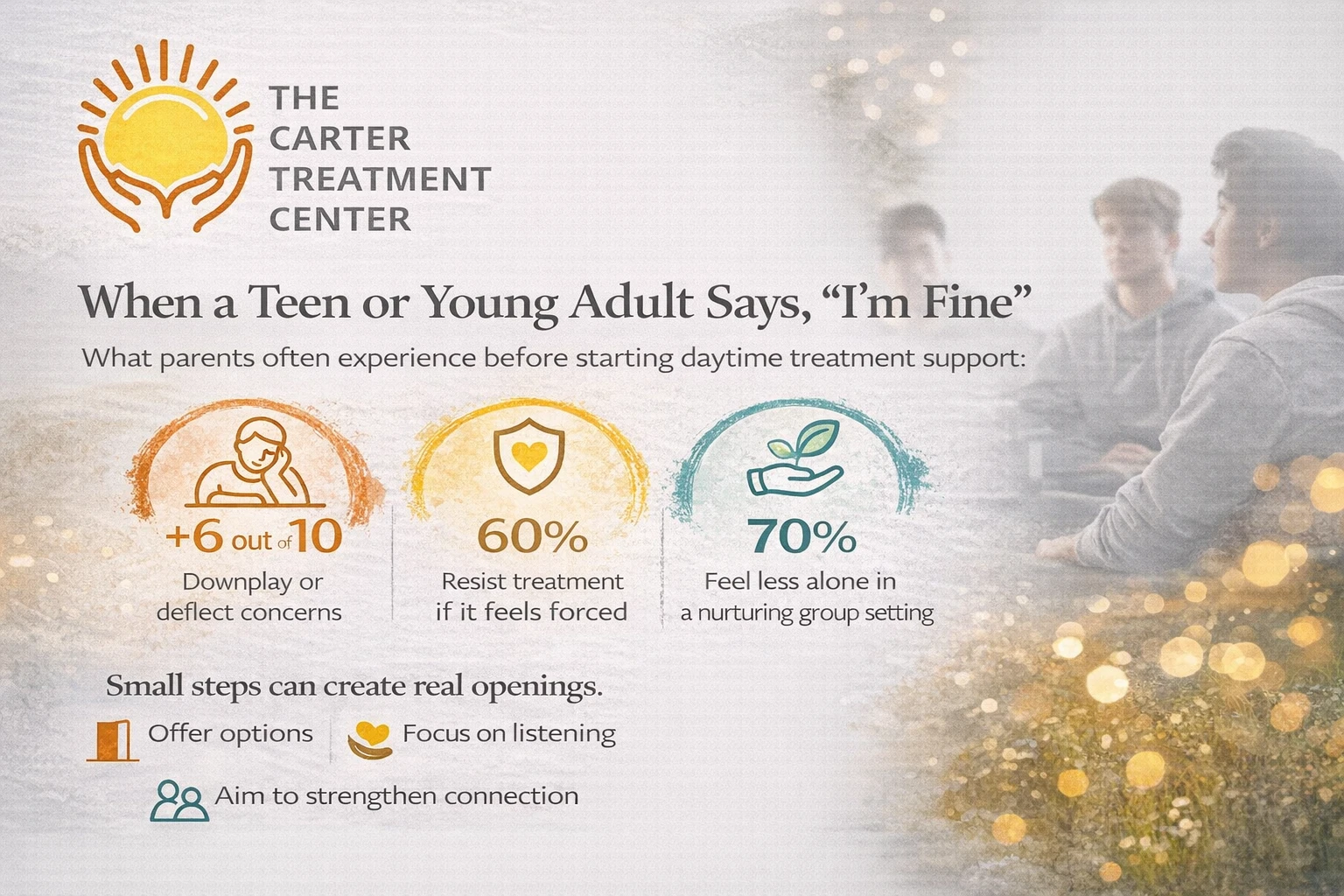
What We See Clinically When Young Adults Start Here
From the outside, it might not look like much at first.
They may show up guarded. Quiet. Disengaged.
We see that all the time.
But something subtle begins to happen over days and weeks.
They start listening to others.
They recognize pieces of themselves in someone else’s story.
They begin to feel less alone, even if they don’t say it out loud.
Then, slowly, their guard lowers.
Not all at once. Not dramatically.
Just enough to let something real come through.
That’s where change begins—not in a breakthrough moment, but in a small shift in openness.
A Story That Might Feel Uncomfortably Familiar
There was a family we worked with whose son had just turned 20.
On paper, things looked “fine.” He wasn’t in crisis. He hadn’t completely fallen apart. But something was clearly off—emotionally distant, inconsistent, avoiding deeper conversations.
Every attempt to talk about help turned into an argument.
His parents were exhausted. Scared. Running out of ways to reach him.
Instead of pushing him toward something he would reject, they reframed the conversation.
Not “you need treatment.”
But “what if you just had a place to talk things through?”
That shift mattered.
He agreed—reluctantly.
The first week, he barely engaged. Arms crossed. Minimal eye contact. Just getting through it.
By the second week, he started listening more closely.
By the third, he shared something small.
Then something real.
It wasn’t forced. It wasn’t dramatic.
But it was movement.
And sometimes, movement is all you need to begin.
What Your Role Looks Like Right Now
This may not be the role you expected to play.
You want to fix it. To protect them. To get them to safety as quickly as possible.
But right now, your role is something quieter—and just as important.
You’re creating openings instead of ultimatums.
You’re offering options instead of demands.
You’re holding steady when everything feels uncertain.
That doesn’t mean you’re passive.
It means you’re strategic in a way that keeps the door open.
The Weight You’re Carrying Is Real
Let’s name something clearly.
This is exhausting.
Loving someone who is struggling—and not fully acknowledging it—can feel like living in constant tension.
You might be:
- Replaying conversations in your head
- Wondering if you’re doing too much or not enough
- Feeling guilty, frustrated, scared—all at once
That emotional weight doesn’t mean you’re failing.
It means you care deeply.
And it’s okay to admit that this is hard.
Why This Approach Can Bridge the Gap
When someone isn’t ready for full acknowledgment, they’re also not ready for something that feels extreme.
But they might be ready for something that feels manageable.
Structured daytime care doesn’t demand identity shifts or big declarations.
It simply offers a place where your child can begin to:
- Understand their own patterns
- Hear perspectives they can relate to
- Experience support without pressure
And often, that’s enough to move them from denial… to curiosity.
From resistance… to openness.
From stuck… to starting.
Finding Support That Feels Within Reach
Practicality matters more than most people realize.
If support feels too far away—emotionally or physically—it becomes harder to accept.
But when care feels accessible, it removes one more barrier.
Some families find it helpful to explore options that are close enough to feel realistic, including services available in Alpharetta, Georgia.
Others may look for support that fits into their daily logistics while still offering consistency.
You don’t need to figure out the perfect solution right away.
You just need something that feels possible enough to try.
FAQ: What Parents Ask When They’re in This Stage
What if my child completely refuses help?
That’s very common. Instead of pushing for full agreement, try introducing smaller, less intimidating options. Openness often grows gradually, not all at once.
How do I talk to them without triggering defensiveness?
Focus on what you’ve observed and how you feel, rather than labeling their behavior. “I’ve noticed you seem overwhelmed lately” often lands better than “You need help.”
What if they agree but don’t really participate?
Engagement can take time. Showing up is the first step. Many young adults begin opening up after they feel safe enough.
Is this enough if things feel serious?
It can be a meaningful starting point. For many, this level of support builds awareness and trust, which can lead to deeper engagement over time.
How do I balance support with boundaries?
You can offer help while still maintaining clear boundaries. Supporting access to care is not the same as removing accountability.
What if I feel like I’ve already tried everything?
Different environments create different responses. Just because something didn’t work before doesn’t mean nothing will.
How long does it take to see change?
Change doesn’t follow a fixed timeline. Some shifts happen quickly, others take time. What matters is movement, even if it’s small.
You Don’t Have to Force the Breakthrough
It’s easy to believe that change has to come from a big moment.
A realization. A confrontation. A turning point.
But more often, change happens quietly.
In a room where they feel safe enough to listen.
In a conversation where they don’t feel judged.
In a moment where something finally clicks—just a little.
You don’t have to force that moment.
You just have to help create the conditions where it can happen.
There Is Still a Way Forward
Even if it doesn’t feel like it right now.
Even if conversations keep ending the same way.
Even if your child insists they’re okay.
There is still movement possible here.
Not through pressure.
Not through control.
But through patience, presence, and the right kind of support.
And sometimes, that middle step—the one that doesn’t feel too big or too small—is what finally helps things begin to shift.
Call (404) 689-9980 or visit our partial hospitalization program in Metro Atlanta to learn more.