


You’ve probably gone back and forth on this more than once.
“Maybe I’m overreacting.”
“But what if I’m not?”
That tension—between needing help and questioning if you deserve it—can feel exhausting. And when you start looking into treatment options, it can quickly become overwhelming.
If you’re trying to understand the difference between levels of care, you’re already doing something important: you’re paying attention to yourself. Let’s slow this down and make it clearer.
Why Choosing a Level of Care Feels So Confusing
Most people don’t grow up learning how treatment works.
So when you finally start looking into it, you’re hit with unfamiliar terms, different program types, and decisions that feel like they carry a lot of weight.
It’s not just a practical choice.
It feels emotional.
Because underneath it all is the question:
“How bad is this, really?”
And that’s not an easy thing to answer on your own.
The Core Difference Comes Down to Your Environment
At the simplest level, the difference is about where you are during treatment.
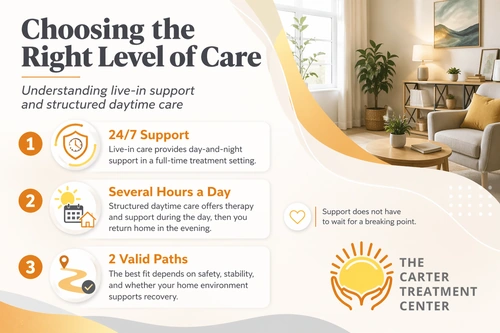
- Live-in treatment means staying at a facility full-time, with support available day and night
- Structured daytime care means attending treatment for several hours during the day, then returning home afterward
That’s the technical difference.
But emotionally, it feels like this:
Live-in care can feel like stepping out of your life completely so you can stabilize without distractions.
Daytime care feels more like learning how to rebuild while still living your life in real time.
Neither is better. They just meet you in different places.
What It Feels Like to Need More Support
A lot of people hesitate here because they think needing more help has to look extreme.
It doesn’t.
Sometimes it looks like:
- Waking up already overwhelmed
- Feeling like your mind doesn’t quiet down, even when everything around you is still
- Using alcohol or other coping habits more often than you want to admit
- Having moments where you feel okay—but they don’t last
It’s not always visible from the outside.
But inside, it can feel like you’re constantly trying to keep things from slipping.
Where Structured Daytime Care Fits Into the Picture
This is often where people land when they’re not in immediate crisis—but they also know things aren’t manageable on their own.
If you’ve come across comparisons like PHP vs IOP, what you’re really trying to understand is how much structure you need.
Structured daytime care usually means:
- Attending therapy and support sessions for several hours a day
- Going multiple days a week
- Returning home each evening
It gives you consistent support without completely removing you from your daily life.
For some, this feels like the first time things start to stabilize—not because everything is fixed, but because they’re no longer carrying it alone.
If you want a clearer picture of how this level of care works, you can explore this breakdown of a partial hospitalization program and what to expect from it.
When Full-Time, Live-In Support Might Be the Right Call
There are moments when staying in your current environment makes it harder to get better.
Not because you’re weak—but because the situation around you is heavy, familiar, or triggering.
Full-time care might make more sense if:
- You feel unsafe being alone with your thoughts
- Substance use feels out of control or unpredictable
- You’ve tried outpatient options before and it didn’t stick
- Your environment doesn’t support recovery right now
This level of care creates space.
Space to breathe.
Space to stabilize.
Space to reset without constant pressure.
You Don’t Have to “Qualify” for Help
This is one of the most common unspoken fears.
People think:
“Someone else probably has it worse.”
“Maybe I should just push through.”
But support isn’t something you earn by reaching a breaking point.
It’s something you choose because you’re tired of carrying everything alone.
Some people need full-time care.
Some need structured daytime support.
Both are valid. Both are real steps forward.
How Your Daily Life Can Help Guide the Decision
Instead of trying to label your situation perfectly, it can help to ask a different question:
“What kind of support would actually help me get through a week right now?”
Think about:
- Can you manage evenings safely and consistently?
- Does being at home help you feel grounded—or overwhelmed?
- Are your responsibilities manageable, or do they feel like too much?
Your answers don’t have to be perfect.
They just need to be honest.
The Middle Ground That Many People Overlook
There’s a quiet space between “I’m fine” and “I need to disappear from my life to get help.”
That space is where structured daytime care often lives.
It allows you to:
- Stay connected to your life
- Practice new coping tools in real time
- Build consistency without isolation
For many people, it’s not about choosing the most intensive option.
It’s about choosing the most sustainable one.
You’re Allowed to Take This One Step at a Time
You don’t need to map out your entire recovery today.
You don’t need to be 100% certain.
You just need to take one step toward support.
For some people, that starts with a conversation.
For others, it’s learning more about what their options actually look like in real life.
If you’re exploring options locally, many people in Alpharetta, Georgia begin by looking into structured daytime programs because they offer balance—support during the day and familiarity at night.
Others find that understanding the difference between levels of care helps reduce the fear of choosing “wrong.”
Either way, clarity tends to come after movement—not before it.
A Thought That Might Stay With You
There’s a quiet shift that happens for a lot of people at this stage.
It’s not dramatic.
It’s just the realization that maybe…
you don’t have to keep doing this alone.
And that thought—small as it is—can change everything.
FAQs: What People Usually Wonder at This Stage
How do I know if I need more than outpatient support?
If you feel like weekly therapy or minimal support isn’t enough to help you stay steady, it may be time to consider a more structured option. It’s less about severity and more about consistency and stability.
Is live-in treatment only for severe cases?
Not necessarily. While it’s often used for higher levels of need, it’s really about whether your current environment supports your recovery. If it doesn’t, full-time care can help create a safer space.
Can I work or take care of responsibilities in daytime programs?
In many cases, yes—though it depends on the schedule. These programs are designed to provide support while still allowing some connection to daily life.
What if I choose the wrong level of care?
This is more common than people think—and it’s okay. Treatment plans can be adjusted. You’re not locked into one path forever.
Is it normal to feel scared about starting treatment?
Completely. Most people feel uncertain at first. Fear doesn’t mean it’s the wrong decision—it usually means it matters.
How do I even start?
You don’t need to have everything figured out. Starting with a simple conversation can help you understand your options and what might fit best for you.
Ready to Talk It Through?
You don’t have to figure this out alone. If you’re weighing your options or just need someone to help you make sense of what you’re feeling, support is available.
Call (404) 689-9980 to learn more about our Partial Hospitalization Program in Metro Atlanta.