


Have you ever agreed to do something you didn’t actually want to do—only to put it off until the last minute?
Or maybe you’ve found yourself saying, “I’m fine,” while secretly feeling hurt or angry.
Perhaps someone in your life avoids direct conflict but expresses frustration through sarcasm, silence, forgotten commitments, or subtle criticism instead.
These situations often involve passive-aggressive behavior.
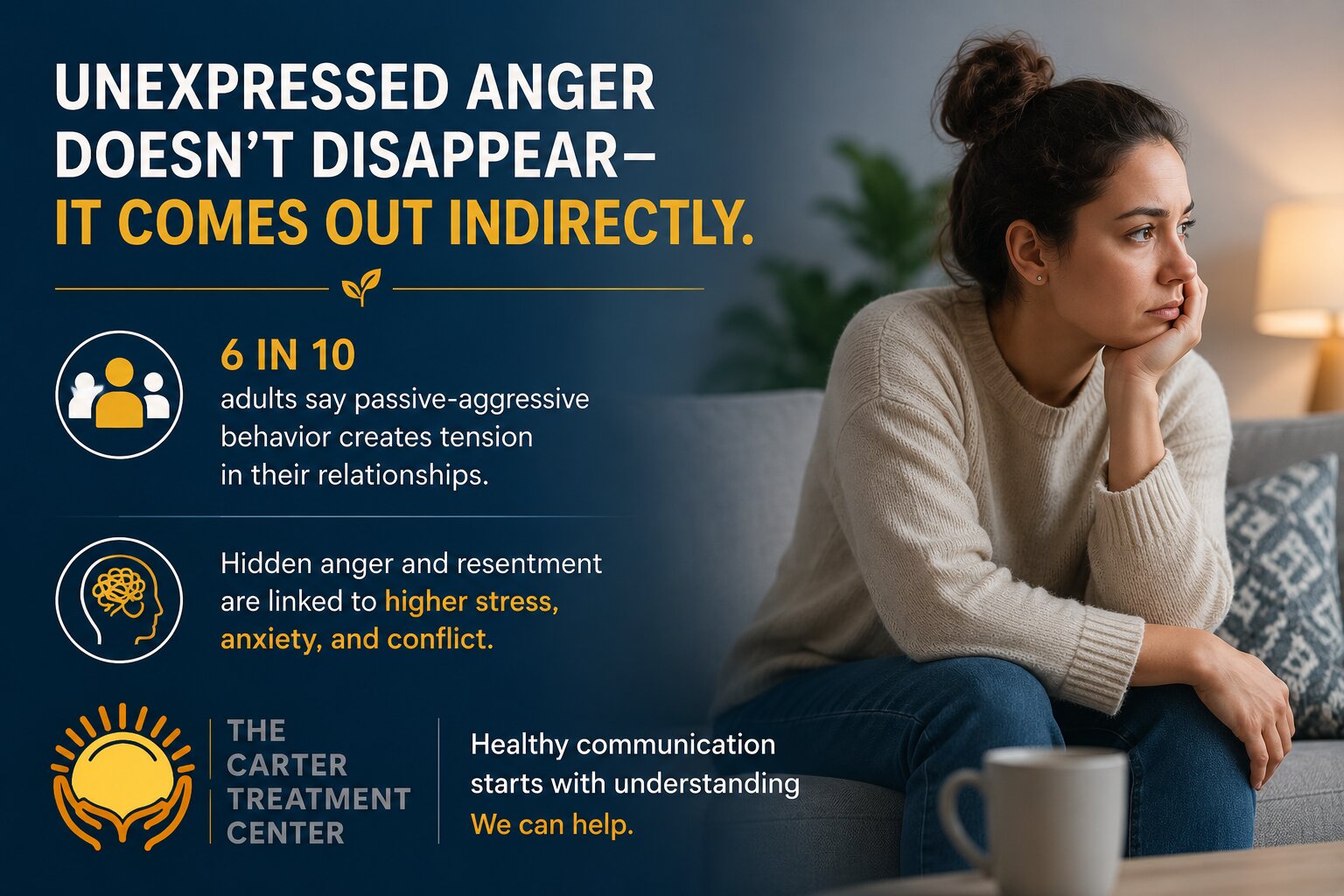
Although it may look like stubbornness, laziness, or poor communication on the surface, passive-aggressive behavior is often rooted in emotions that feel too difficult, unsafe, or uncomfortable to express directly. In many cases, it reflects unexpressed anger rather than an absence of anger.
Understanding where these behaviors come from is important because they can create ongoing tension in relationships, workplaces, and families. More importantly, they can prevent people from addressing the real issues beneath the surface.
At The Carter Treatment Center, we help adults throughout North Atlanta—including Alpharetta, Cumming, and Jefferson—develop healthier ways to recognize, express, and manage difficult emotions through compassionate anger management treatment and outpatient mental health care.
What Passive-Aggressive Behavior Is
Passive-aggressive behavior is a pattern of expressing negative emotions indirectly rather than communicating them openly.
Instead of saying:
“I’m upset.”
Someone may:
- Agree while secretly resisting.
- Avoid completing responsibilities.
- Become unusually quiet.
- Use sarcasm.
- Make subtle critical remarks.
- Withdraw emotionally.
- Express frustration through actions instead of words.
The important distinction is that the anger or resentment is still present.
It simply appears indirectly rather than through open conversation.
Many people who engage in passive-aggressive behavior are not trying to manipulate others intentionally.
Often, they genuinely struggle to express disappointment, frustration, hurt, or anger in healthy ways.
Some grew up in homes where conflict was discouraged.
Others learned that expressing anger resulted in punishment, rejection, or shame.
Over time, indirect communication became a coping strategy.
Common Examples
Passive-aggressive behavior can appear differently from one person to another.
Some of the most common examples include:
The Silent Treatment
Instead of discussing a disagreement, someone may stop speaking to another person entirely.
Silence becomes the message.
Although taking space to calm down can be healthy, prolonged silence used to communicate anger often prevents problems from being resolved.
Procrastination as Protest
Someone agrees to complete a task but repeatedly delays it because they resent being asked.
Rather than saying:
“I don’t want to do this.”
They express frustration by avoiding the responsibility.
Backhanded Compliments
These comments appear positive on the surface while containing hidden criticism.
Examples include:
- “I’m surprised you finished that so quickly.”
- “You actually did a great job.”
- “That outfit is much better than what you usually wear.”
These statements can create confusion because they mix praise with subtle negativity.
Chronic Lateness
Repeatedly arriving late may sometimes communicate anger, resentment, or resistance without saying so directly.
Not every instance of lateness is passive-aggressive, but when it consistently occurs in response to certain people or situations, it may reflect unspoken feelings.
Subtle Sabotage
Someone may:
- Forget important tasks
- “Accidentally” make mistakes
- Leave responsibilities unfinished
- Withhold helpful information
Rather than refusing directly, they indirectly communicate resentment through their actions.
Sarcasm That Hides Anger
Humor can be healthy.
However, repeated sarcastic comments that mask criticism may become another way of expressing anger without addressing it openly.
Why People Do It
Passive-aggressive behavior rarely develops without a reason.
Understanding those reasons can help reduce blame while creating opportunities for healthier communication.
Fear of Conflict
Many people never learned that disagreements can be safe.
If conflict always led to yelling, rejection, or punishment during childhood, expressing anger directly may feel threatening.
Indirect communication feels emotionally safer.
Difficulty Identifying Emotions
Some individuals struggle to recognize what they are feeling.
Instead of noticing:
“I’m angry.”
They simply experience irritation, avoidance, or resentment without understanding why.
Therapy often helps people become more aware of these emotional patterns.
Learned Family Patterns
Children often copy the communication styles they observe.
If caregivers avoided direct conversations about conflict, children may adopt similar strategies as adults.
They may never have learned healthy ways to express frustration.
Fear of Hurting Others
Some people worry that expressing anger makes them a “bad person.”
Rather than risking conflict, they suppress their emotions until resentment emerges indirectly.
Ironically, avoiding direct conversations often causes greater damage over time.
Feeling Powerless
When someone believes they cannot openly disagree with a parent, partner, supervisor, or authority figure, indirect behavior may feel like the only available option.
Although understandable, this rarely resolves the underlying problem.
How Passive-Aggressive Behavior Damages Relationships
Because passive-aggressive behavior avoids direct communication, problems often remain unresolved.
Over time, this creates frustration for everyone involved.
Trust Begins to Erode
Partners, family members, and coworkers may struggle to understand what is actually wrong.
Mixed messages create uncertainty.
Resentment Builds
Unspoken frustrations rarely disappear.
Instead, they often grow larger with time.
Small disagreements become long-term relationship problems.
Communication Stops Feeling Safe
When people cannot rely on honest conversations, they may begin avoiding difficult topics altogether.
This emotional distance can weaken even close relationships.
Conflict Lasts Longer
Direct conversations are uncomfortable.
Indirect conflict often lasts much longer because the original issue is never clearly discussed.
Emotional Intimacy Declines
Healthy relationships depend on honesty.
When emotions remain hidden behind sarcasm, avoidance, or resentment, genuine connection becomes much more difficult.
How Therapy Can Help
The encouraging news is that passive-aggressive behavior is not a permanent personality trait.
It is a learned communication pattern that can change.
Therapy focuses on understanding what drives the behavior rather than simply criticizing it.
At The Carter Treatment Center, treatment begins by exploring the emotional experiences beneath indirect communication.
Depending on an individual’s needs, therapy may help people:
Recognize Hidden Anger
Many people are surprised to discover how often they suppress frustration before it appears indirectly.
Increasing emotional awareness is often the first step toward healthier communication.
Develop Healthy Communication Skills
Instead of avoiding difficult conversations, therapy teaches skills for expressing emotions respectfully and clearly.
Learning to say:
“I felt hurt.”
“I disagree.”
“I need help.”
can prevent resentment from building over time.
Understand Emotional Triggers
Certain situations may consistently activate feelings of rejection, criticism, unfairness, or helplessness.
Recognizing these triggers allows people to respond more intentionally instead of reacting automatically.
Build Assertiveness
Assertiveness differs from aggression.
It involves expressing thoughts, feelings, and needs honestly while respecting the rights of others.
For many people, this is an entirely new skill.
Improve Relationships
As communication becomes more direct, misunderstandings often decrease.
Couples, families, friendships, and workplace relationships frequently become healthier because problems can finally be discussed openly.
When to Consider Professional Support
It may be helpful to seek support if:
- You frequently avoid difficult conversations.
- People tell you they never know how you really feel.
- Conflict repeatedly damages important relationships.
- You notice resentment building over time.
- You often express frustration indirectly instead of discussing it openly.
- Anger feels difficult to recognize or control.
Professional therapy provides a supportive environment to understand these patterns without judgment.
Final Thoughts
Passive-aggressive behavior is often misunderstood as simple stubbornness or poor attitude. In reality, it frequently reflects unexpressed anger, fear of conflict, or communication patterns that developed over many years.
Recognizing these behaviors is not about assigning blame. It is about understanding what emotions are being hidden and learning healthier ways to express them.
With greater self-awareness, improved communication skills, and professional support, it is possible to replace indirect expressions of anger with honest, respectful conversations that strengthen relationships instead of damaging them.
At The Carter Treatment Center, we provide compassionate outpatient mental health services for adults throughout Alpharetta, Cumming, Jefferson, and the greater North Atlanta area. If anger, resentment, or communication challenges are affecting your daily life or relationships, our team can help you develop healthier ways to understand and express difficult emotions. Call us today at 404.689.9980 to learn more about our treatment programs and take the first step toward a healthier, more fulfilling future.
Frequently Asked Questions
What is passive-aggressive behavior?
Passive-aggressive behavior is an indirect way of expressing anger, frustration, or resentment instead of communicating those emotions openly. It may involve behaviors such as procrastination, sarcasm, the silent treatment, subtle criticism, or intentionally avoiding responsibilities.
Why do people act passive-aggressively?
People may act passive-aggressively because they fear conflict, grew up in environments where anger was discouraged, struggle to identify or express emotions, or feel powerless to communicate their needs directly. These behaviors are often learned coping strategies rather than intentional attempts to harm others.
How do you deal with passive-aggressive behavior?
If you notice passive-aggressive behavior in yourself, developing emotional awareness and practicing direct, respectful communication can help. If you’re dealing with someone else’s behavior, responding calmly, encouraging honest conversation, and setting healthy boundaries are often more effective than reacting with anger. Therapy can also help address the underlying emotional patterns that contribute to indirect communication.