


The hardest day for me wasn’t the day I checked into the hospital.
It was the day I left.
People often imagine discharge as a victory lap. Family members are relieved. Friends send encouraging messages. Everyone wants to believe the worst is behind you.
Part of me wanted to believe that too.
But as I packed my things and prepared to go home, I felt something I wasn’t expecting.
Fear.
Not because I didn’t want to leave. I did.
I missed my own bed. I missed familiar routines. I missed having some control over my day.
What scared me was the realization that the world I had stepped away from was still waiting for me.
The same responsibilities.
The same stressors.
The same relationships.
The same thoughts that had slowly become overwhelming before I ended up in the hospital.
If you’ve recently experienced a psychiatric hospitalization, or you’re helping someone who has, you may understand this feeling. The transition home can feel surprisingly vulnerable. That’s why learning about options like structured daytime care can be such an important part of the recovery process.
The Hospital Created Safety
Looking back, I can admit something that was difficult to say at the time.
I needed that level of care.
Before I was hospitalized, life felt like it was shrinking around me.
Simple tasks felt impossible.
My thoughts felt louder than everything else.
I was exhausted from trying to convince people I was okay when I clearly wasn’t.
The hospital created something I hadn’t had in a long time:
Safety.
Not just physical safety.
Emotional safety.
For a few days, my only job was to stabilize.
I didn’t have to manage work emails.
I didn’t have to pretend everything was fine.
I didn’t have to carry every responsibility by myself.
That pause mattered.
It gave me enough breathing room to begin healing.
The Real World Doesn’t Wait for Recovery
One thing nobody prepared me for was how quickly normal life returns.
Within days of discharge, expectations started creeping back in.
People asked when I’d return to work.
Bills still needed attention.
Family dynamics were still complicated.
Daily stressors hadn’t disappeared simply because I’d spent time in the hospital.
I remember sitting in my living room a few days after discharge feeling completely overwhelmed.
Nothing dramatic had happened.
But everything felt heavy.
The structure that had helped me stabilize was suddenly gone.
And I realized something important:
Leaving the hospital didn’t mean I was fully recovered.
It meant I was ready for the next stage of recovery.
Those are not the same thing.
Why the Time After Discharge Can Feel So Uncomfortable
Many people experience an emotional whiplash after hospitalization.
Inside the hospital, support is built into the day.
Meals happen at scheduled times.
Groups happen at scheduled times.
Medication management happens at scheduled times.
There is accountability.
There is routine.
Then suddenly you’re home.
Freedom feels good.
Until it feels overwhelming.
Many people assume they should immediately know how to manage everything again. When they struggle, they often interpret it as failure.
It’s not.
It’s a normal part of transitioning back into everyday life.
The truth is that healing often happens gradually.
Stability isn’t something most people regain overnight.
I Thought Needing More Help Meant I Was Moving Backward
One of the biggest mistakes I made after discharge was believing I should be able to handle everything on my own.
I told myself that asking for additional support meant I wasn’t getting better.
I thought needing continued treatment somehow erased the progress I had already made.
What I eventually learned was the opposite.
Recovery isn’t measured by how quickly you stop needing help.
Recovery is measured by your willingness to use support when you need it.
That’s a very different standard.
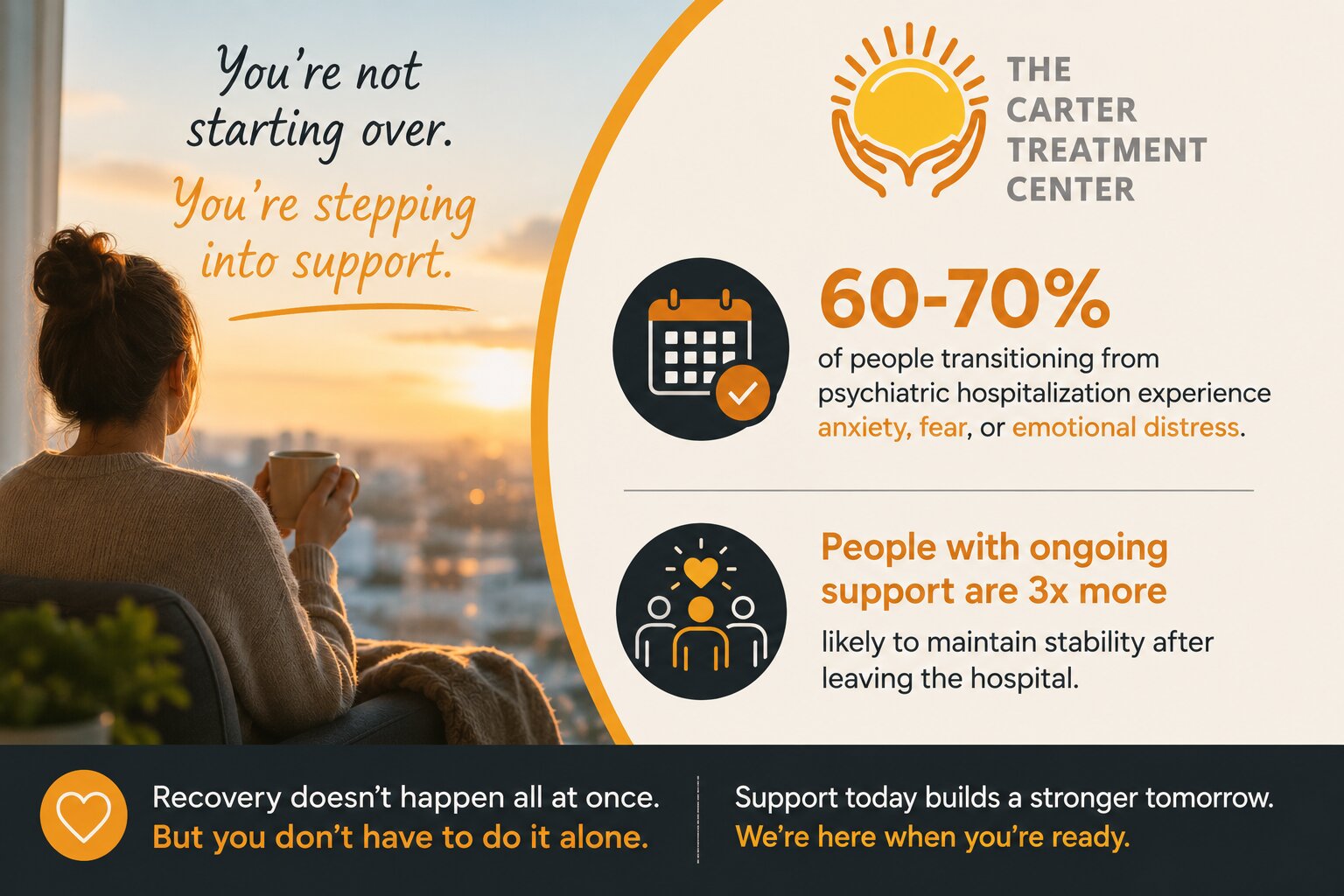
For many people, continued treatment after hospitalization provides a bridge between crisis stabilization and long-term independence.
Without that bridge, the gap can feel enormous.
The Middle Ground Made Recovery Feel Possible
For a while, I saw treatment in extremes.
Either I was hospitalized, or I was completely on my own.
What I didn’t understand was that recovery includes a lot of space in between.
There are levels of support designed specifically for people who are stable enough to leave the hospital but still need structure, accountability, and clinical care.
That middle ground changed everything for me.
Instead of trying to navigate recovery entirely alone, I had a place to continue building skills.
I had support while learning how to manage stress differently.
I had opportunities to process setbacks before they became crises.
Most importantly, I wasn’t expected to figure everything out immediately.
The best metaphor I can offer is this:
The hospital helped me get out of the storm.
Continued support taught me how to rebuild afterward.
Progress Rarely Looks Like People Expect
One of the most frustrating parts of recovery is how ordinary progress can seem.
I expected dramatic breakthroughs.
I expected obvious signs that things were getting better.
Instead, progress looked like:
- Sleeping through the night more consistently
- Answering phone calls I used to avoid
- Going for a walk when I felt overwhelmed
- Recognizing warning signs earlier
- Reaching out before things escalated
- Having fewer crisis moments
None of those changes felt life-changing in the moment.
But together they created something important.
Momentum.
Healing often happens quietly.
Looking back months later, you realize you’ve traveled much farther than you thought.
Recovery After a Setback Doesn’t Mean Starting Over
If you’re reading this after a psychiatric hospitalization, there’s a good chance you’re carrying some shame.
Many people do.
They feel embarrassed they needed help.
They worry they’ve disappointed family members.
They question whether they’ll ever truly feel stable.
I’ve had those thoughts too.
But here’s something worth remembering:
A hospitalization isn’t proof that you’ve failed.
It’s evidence that you sought help during one of the most difficult moments of your life.
That takes courage.
And if you need continued support afterward, that doesn’t erase the progress you’ve already made.
Recovery isn’t a straight line.
It’s a process of learning, adjusting, recovering, and continuing forward.
Why Ongoing Structure Matters
Many people search for support after hospitalization because they know they’re not in crisis anymore, but they also know they’re not quite ready to do everything alone.
That’s where additional support can play an important role.
Some individuals benefit from a mental health step down program that provides ongoing therapeutic structure while helping them gradually rebuild confidence and independence.
The goal isn’t to stay in treatment forever.
The goal is to strengthen the foundation underneath your recovery.
Think about physical rehabilitation after a serious injury.
Nobody expects a person to leave the hospital and immediately run a marathon.
Mental health recovery deserves the same patience.
Healing takes practice.
FAQ: Support After Psychiatric Hospitalization
What happens after psychiatric hospitalization?
The next steps vary depending on individual needs. Many people continue with therapy, medication management, support groups, or structured treatment programs designed to help maintain stability after discharge.
Is it normal to feel anxious after leaving the hospital?
Yes. Many individuals experience uncertainty, fear, or emotional vulnerability after discharge. Transitioning from a highly structured environment back into daily life can feel overwhelming at first.
Does needing additional treatment mean hospitalization didn’t work?
No. Hospitalization often focuses on stabilization and safety. Continued treatment helps people build skills, routines, and coping strategies that support long-term recovery.
How long should support continue after discharge?
There is no universal timeline. Recovery needs vary from person to person. Treatment recommendations are based on symptoms, progress, support systems, and individual goals.
What if I feel like I’m struggling again?
Reach out sooner rather than later. Many people benefit from additional support before symptoms become severe enough to require another hospitalization.
Is it common to need multiple levels of care?
Very common. Mental health recovery often involves moving between different levels of support as needs change over time.
Can I continue living at home while receiving support?
Depending on treatment recommendations, many individuals participate in structured programs during the day while returning home in the evenings.
How do I know if I need more support?
If you’re feeling overwhelmed, struggling to manage symptoms, experiencing increased distress, or worried about maintaining progress, it’s worth discussing options with a mental health professional.
If you’re exploring care in metro atlanta after a hospitalization, understanding available levels of support can help you find a path that feels manageable and sustainable.
The day I left the hospital wasn’t the end of my recovery story.
It wasn’t even the chapter where everything suddenly got better.
It was the chapter where I stopped trying to do it alone.
And for me, that changed everything.
Call (404) 689-9980 or visit our partial hospitalization program services to learn more about our partial hospitalization program services Alpharetta, GA.