


There wasn’t some big crash. No overdose. No messy intervention.
Just the quiet kind of unraveling that happens when you’ve been white-knuckling your life for years.
The exhaustion wasn’t just physical—it was emotional. I was keeping up appearances, checking every box, performing just well enough to convince the world (and myself) that everything was fine.
But I wasn’t okay. I knew it.
And I didn’t know how to ask for help without burning it all down.
That’s how I ended up in an intensive outpatient program. And honestly? It saved my life without blowing it up.
If you’re where I was, let me tell you what I wish someone had told me.
👉 Explore the intensive outpatient program that worked for me.
I Wasn’t “Falling Apart.” I Was Fading.
There’s this idea that addiction has to look dramatic to count.
But for people like me—the high-functioning ones—it often doesn’t. I wasn’t missing work. I wasn’t alienating my family. I wasn’t drinking in the morning. I was showing up. I was producing. I was even smiling.
But I was fading behind all of it. My thoughts were hazy. My moods unpredictable. I needed substances to wind down, to socialize, to sleep, to feel anything. And the truth is: I was always calculating my next drink, my next high, or my next excuse.
I didn’t feel “out of control.” I felt… dulled. Frayed.
Like I was aging faster than my body.
IOP Gave Me Structure—Without Requiring Collapse
I used to think the only way to get help was to hit bottom so hard you had no choice but to go away—to rehab, to detox, to somewhere that required disappearing from your life.
But when I learned about intensive outpatient programs (IOPs), I realized there was another path. A middle ground.
An IOP offers structured, therapeutic support three to five days a week—with sessions in the evenings or daytime, depending on your schedule. You get group therapy, individual counseling, and tools that help you actually understand what’s driving your use.
For me, it meant I could:
- Keep my job.
- Be home with my family.
- Stop pretending I didn’t need help.
And most of all: I could start changing my life without pausing it.
I Wasn’t the Only One Living a Double Life
Walking into that first group, I was sure I didn’t belong.
I was dressed for work. I had just answered emails from my boss. I had dinner to make after. How could I be one of them?
But as we went around the circle, I heard story after story that sounded eerily like mine:
- “I plan meetings around when I can use without anyone noticing.”
- “I can’t sleep without drinking, and I’m tired of lying to myself about it.”
- “From the outside, I look successful—but I feel like a fraud.”
It hit me: This is addiction too.
Quiet, well-dressed, fully functional—but hollow.
That group became one of the only places where I didn’t have to pretend. And that honesty changed everything.
What Healing Looked Like for Me
There was no dramatic breakthrough. No tearful confessional.
Healing was subtle, then sudden. At first, it just looked like:
- Going to therapy instead of going numb
- Feeling anxious and letting it pass instead of chasing a buzz
- Eating breakfast without a hangover
- Calling someone instead of isolating
Then one day, I sat still. No noise, no drink, no screen. Just me.
And I felt okay. Present. Alive. Like myself.
That was the day I realized the IOP wasn’t just helping me stop using—it was helping me start living.
IOP Helped Me Learn What I Was Actually Running From
Before IOP, I thought my problem was stress. Or my schedule. Or other people’s expectations.
But beneath all of that was something deeper: avoidance.
I used substances to avoid discomfort. Conflict. Loneliness. Self-doubt.
And once I stopped avoiding, I had to start feeling.
IOP helped me do that safely.
With therapists who didn’t flinch.
With peers who didn’t judge.
With skills that actually made it bearable.
It wasn’t easy. But it was real.
You Don’t Have to Wait for a Breakdown to Start Healing
If you’re waiting for a sign that it’s bad enough to get help, this is it.
Because here’s the truth:
- If you’re Googling “intensive outpatient program,” you probably already know.
- If your habits feel heavier than they used to—trust that.
- If you’re doing everything right and still feel wrong—trust that too.
You don’t have to lose everything to get help.
You can keep your job, your family, your rhythm—and still radically change your relationship to substances.
And if you’re looking for support in metro Atlanta, The Carter Treatment Center offers flexible, non-judgmental IOP care that works for people like us—the high-functioning, the exhausted, the quietly unraveling.
👉 Learn more about our intensive outpatient program services
FAQ: Intensive Outpatient Program (IOP) Questions—Answered
What is an intensive outpatient program?
An intensive outpatient program (IOP) is a structured form of treatment for substance use or mental health that allows you to live at home while attending regular therapy sessions, typically 3–5 days a week for several hours at a time. It’s more intensive than standard outpatient therapy but more flexible than inpatient rehab.
Can I keep working while attending an IOP?
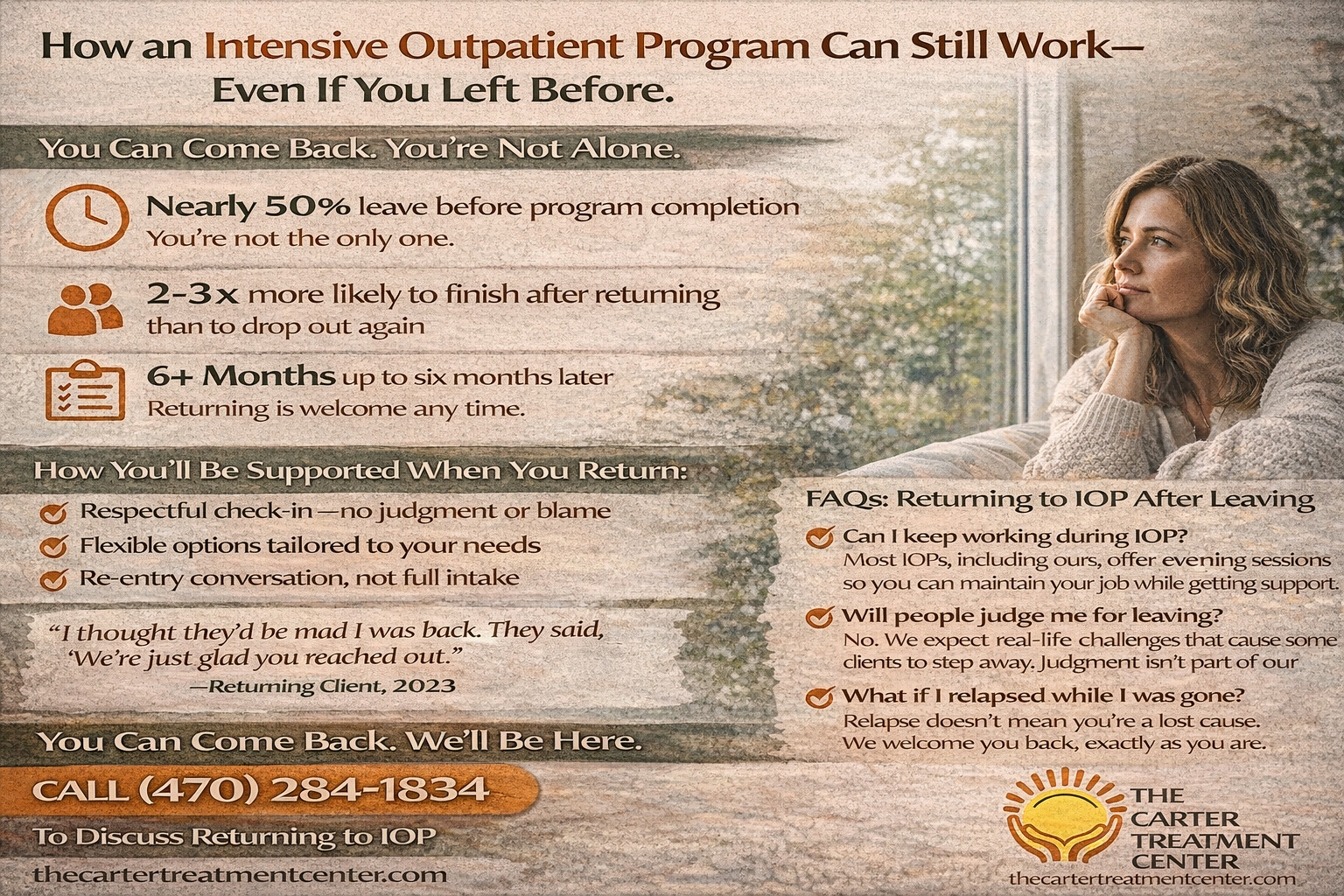
Yes. That’s one of the biggest benefits. Many IOPs, including the one at The Carter Treatment Center, offer evening sessions or flexible scheduling designed specifically so you can maintain your work and family responsibilities.
Do I have to be completely sober before starting IOP?
Not necessarily. IOP can be part of the process of becoming sober. As long as you’re committed to change, you don’t have to have it all figured out before you begin.
What kind of therapy is included in an IOP?
Most IOPs include:
- Group therapy
- Individual counseling
- Psychoeducation (learning about addiction, emotions, coping skills)
- Relapse prevention strategies
Some may also offer trauma therapy, family sessions, and holistic supports depending on the center.
How long does IOP usually last?
Programs typically last 6–12 weeks, but that varies based on your progress and needs. Some people continue in a step-down version of IOP or transition into aftercare programs for continued support.
You Can Keep Your Life—and Still Get It Back
You don’t have to wait for disaster.
You don’t have to hit bottom.
You don’t have to lose your job, your family, or your identity to deserve help.
If you’re exhausted from pretending you’re fine, if your life looks good but feels empty, if you’re scared to stop but more scared to keep going—IOP might be exactly what you need.
📞 Ready to take the first step?
Call (470) 284-1834 or visit to learn more about our intensive outpatient program services in Alpharetta, GA.