


It’s hard to explain the kind of shame that comes with almost getting help.
You showed up for treatment—maybe once, maybe for a few weeks. You had the best intentions. Then life got in the way. Work deadlines. A sick kid. An internal voice whispering, “You’re not like them.”
But here you are again. Same glass of wine too many nights in a row. Same anxiety in the pit of your stomach. Same secret double life. Still holding it all together—barely.
And now you’re wondering: Can I go back to an intensive outpatient program? Is that even allowed? Would it work better this time?
Here’s the truth: Yes. It’s allowed. It’s normal. And it might work better now than it would have before.
At The Carter Treatment Center, we help people re-enter IOP every week—and we do it without shame, lectures, or hoops to jump through.
You’re Not the Only One Who Left
Let’s start by normalizing something most people don’t talk about: not everyone finishes treatment the first time.
That’s not because you’re weak. It’s because recovery—especially outpatient recovery—requires honesty, capacity, and readiness. And when you’re high-functioning, it’s easy to convince yourself you’re not “that bad.”
But here’s what you know now that you didn’t know then:
- White-knuckling it through the workday doesn’t mean you’re okay.
- The version of you that only shows up when sober deserves more space in your life.
- Pretending this isn’t a problem is the problem.
Quitting treatment doesn’t disqualify you from returning. If anything, it makes you more aware of what you actually need.
What an Intensive Outpatient Program Actually Looks Like
If your only memory of IOP is sitting in a circle wondering how you ended up there… you deserve to know: it’s not all group talk and worksheets.
At The Carter Treatment Center, our intensive outpatient program is structured around real-life recovery—especially for people who don’t fit the stereotype.
Here’s what that looks like:
- Therapy you can work around your schedule: 3–5 sessions per week, mornings or evenings.
- Group sessions that don’t waste time: led by experienced clinicians who know how to balance emotional safety with real challenge.
- One-on-one support: to unpack personal blocks, trauma, or relapse patterns that need a different lens this time.
- Holistic care: including movement, meditation, creative therapies, and body-based regulation—because healing doesn’t just happen in your head.
- Skill-building: coping strategies for cravings, anxiety, emotional numbness, and self-sabotage.
You’re not living in a facility. You’re living your life—with a support structure strong enough to hold the parts you’ve been holding alone.
Why People Leave IOP—And Why Returning Is Different
People leave IOP for all kinds of reasons:
- It felt overwhelming, and you didn’t know how to ask for less.
- You were still drinking or using, and it felt hypocritical to keep going.
- You didn’t connect with the group or the format.
- You weren’t ready to be honest—not even with yourself.
Coming back now doesn’t mean you failed. It means you know more.
You’ve seen what happens when you try to white-knuckle it without support. You’ve felt the quiet panic of knowing something’s off—while still showing up to meetings, running your household, or posting perfectly normal photos online.
Returning isn’t starting over. It’s picking up the thread with new clarity.
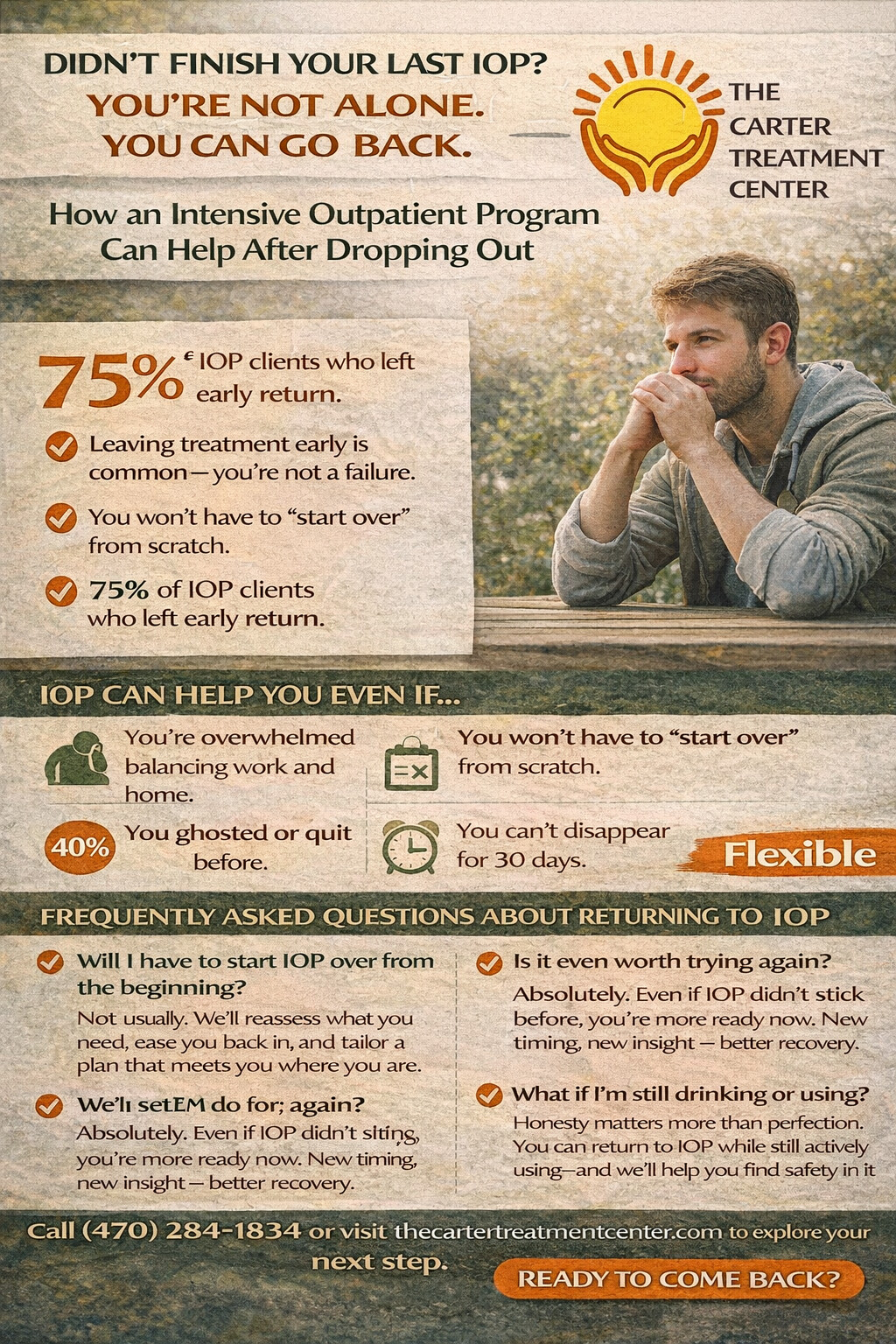
IOP the Second Time Around: What Changes?
You do.
You’re more honest. More tired of the game. Less interested in being impressive. That makes the work deeper.
We also shift how we support you:
- You guide the pace. If you already did the beginner modules, we don’t make you repeat them.
- We start where it makes sense. If you left at week 4, we assess what landed—and what didn’t.
- You’re allowed to bring your skepticism. Some people come back with one foot out the door. We’re not afraid of that. We’d rather work with your doubts than pretend they’re not there.
There’s no ceremony or punishment. Just a quiet return to something you still need—and probably needed all along.
The High-Functioning Trap
If you’re the kind of person who holds it all together, this part is for you.
High-functioning addiction wears a good mask. You might be making money, managing relationships, checking all the boxes. But inside, it’s like you’re split in two: the version the world sees, and the version who drinks in secret, spirals at night, or lies to protect the illusion.
You’re not failing. But you’re not okay.
That kind of split wears people down over time. It’s not just the substance—it’s the silence. The hiding. The constant performance.
At The Carter Treatment Center, we know this profile well. We don’t pathologize it. We work with it. Our job isn’t to tear down your functioning—it’s to help you integrate the parts of yourself you’ve had to keep locked away.
You Still Deserve Support in Metro Atlanta
You don’t have to fly across the country or disappear for 30 days to get real support. Our support in metro Atlanta is accessible, flexible, and tailored for people who need help without blowing up their entire life.
You can come to us quietly. You can keep your job. You can even keep your doubts.
All we ask is that you show up.
FAQs: Returning to an Intensive Outpatient Program
Can I rejoin IOP even if I left on bad terms or ghosted?
Yes. You don’t need a perfect exit to return. We understand that life gets messy. What matters is that you’re here now—and we’ll meet you with an open door, not judgment.
Will I have to start the program over from the beginning?
Not necessarily. We tailor your treatment based on what you’ve already done. We’ll reassess where you are now and build from there.
Is it worth trying again if it didn’t help the first time?
Absolutely. Sometimes the timing, structure, or your internal readiness makes all the difference. Many clients find their second attempt at IOP is far more impactful because they come in with more clarity and motivation.
What if I’m still drinking or using?
That doesn’t disqualify you. Many people enter or return to IOP while still using. Honesty is more important than perfection. We’ll help you find your footing safely.
Do I have to explain why I left before?
Only if you want to. Some people find it helpful to process. Others don’t. We’ll follow your lead.
Ready to Come Back—Even If It’s Just a Call?
If something about this feels like it’s for you, it probably is.
You don’t need to explain or apologize. Just reach out. Whether you left a year ago or a week ago, we’ll help you figure out the next right step.
📞 Call (470) 284-1834 or visit The Carter Treatment Center’s IOP services to learn more about our intensive outpatient program services in Alpharetta, GA.