


There’s a moment that happens for many people after they leave treatment.
Usually, it’s late at night.
The house is quiet.
Work emails are finally done.
The distractions stop for a minute.
And underneath everything else, one thought keeps circling:
I don’t think I’m okay anymore.
But instead of reaching out, many people keep going through the motions.
They keep showing up to work.
Keep answering texts.
Keep saying “I’m just stressed.”
Keep convincing themselves they’ll figure it out alone.
Meanwhile, the drinking gets heavier.
The anxiety gets louder.
The exhaustion deepens.
And the shame of leaving treatment starts becoming its own kind of prison.
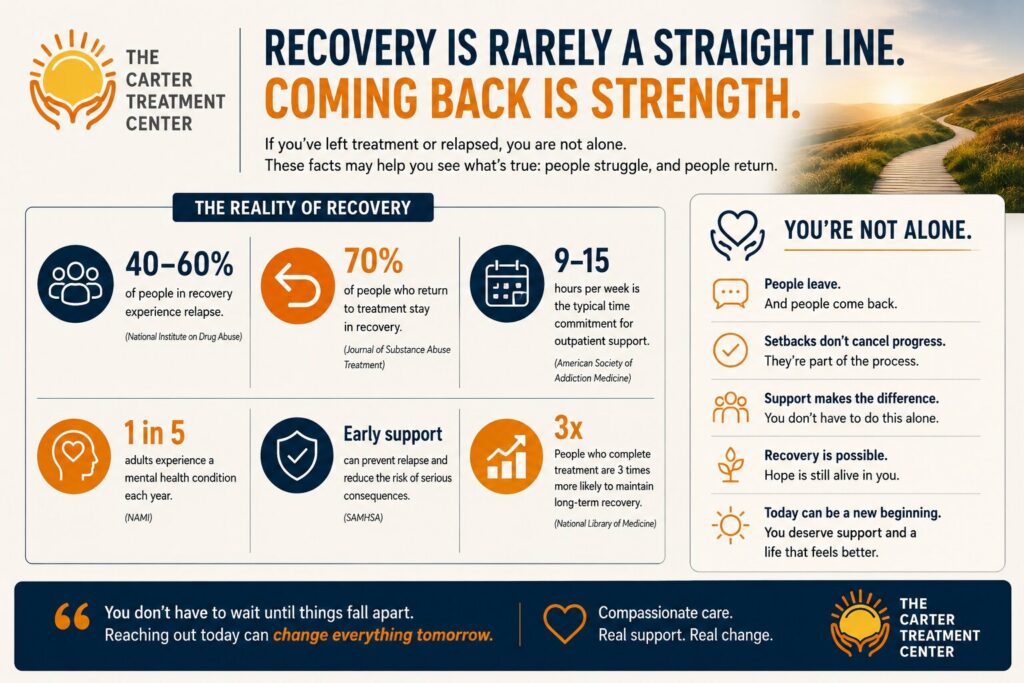
If you disappeared from treatment, stopped returning calls, relapsed, or quietly drifted away from support, you are not alone. More importantly, you are not beyond help. Programs like multi-day weekly treatment exist because recovery is rarely a straight line.
People leave.
People struggle.
People come back.
That’s not failure.
That’s being human.
Stop Believing You Need to “Get Better” Before Coming Back
One of the biggest misconceptions treatment dropouts carry is the belief that they need to stabilize themselves before reaching out again.
They think:
“I need to stop drinking first.”
“I need to get my life together first.”
“I need to prove I’m serious this time.”
“I need to feel motivated again.”
But recovery support is not reserved for people who already feel stable.
In reality, most people return to treatment while feeling:
- Ashamed
- Emotionally exhausted
- Relapsed
- Overwhelmed
- Uncertain
- Burned out
- Scared they’ve ruined everything
That’s normal.
As a clinician, I can tell you this clearly: pretending helps nobody.
The clients who reconnect most successfully are often the ones who stop performing and finally say:
“I’m struggling.”
“I don’t know how bad this got.”
“I thought I could manage it.”
“I need help again.”
Honesty creates room for treatment to actually work.
Performance usually creates more isolation.
Understand That Leaving Treatment Is More Common Than People Realize
A lot of people quietly assume they’re the only person who has ever ghosted treatment.
They’re not.
People leave programs for many reasons:
- Anxiety gets overwhelming
- Depression deepens
- Work pressure increases
- Family responsibilities pile up
- Shame after relapse becomes unbearable
- Emotional vulnerability starts feeling too exposed
- Old coping patterns return
- Progress feels slower than expected
And sometimes people simply get emotionally tired.
Recovery work can be exhausting because it asks people to stop numbing pain they’ve spent years avoiding.
That doesn’t mean treatment failed.
It doesn’t mean you failed either.
It means you’re dealing with something difficult and deeply human.
Be Honest About What’s Actually Happening Now
Many people who left treatment months ago are still trying to minimize what’s happening.
They say things like:
“It’s not that bad.”
“I’m still functioning.”
“I’m still working.”
“I’m only drinking at night.”
“I’m handling it.”
But privately, many are:
- Drinking more than they intended
- Using substances to sleep
- Experiencing worsening anxiety
- Feeling emotionally disconnected
- Hiding how exhausted they are
- Struggling to get through the workday without mentally checking out
- Feeling trapped between needing help and needing to keep functioning
That internal conflict is real.
It’s one reason many people eventually search for support connected to alcohol rehab while working. They know something is wrong, but they cannot imagine disappearing from their responsibilities completely.
And honestly, many people do not need to disappear entirely to begin getting better.
Sometimes they need support structured around real life—not separate from it.
Shame Gets Louder the Longer You Stay Alone
This part matters deeply.
The longer someone stays disconnected from support, the more distorted their thoughts often become.
Shame starts building stories:
“They’re disappointed in me.”
“They probably think I’m hopeless.”
“I already ruined my chance.”
“I’ll never be able to explain this.”
But treatment professionals understand something many struggling people forget:
Relapse, avoidance, isolation, and emotional shutdown are common parts of many recovery journeys.
People disappear all the time.
People come back all the time.
And most clinicians are far less interested in judging you than helping you reconnect before things become more dangerous emotionally or physically.
Sometimes the hardest part of returning is simply tolerating the vulnerability of being seen again.
But healing usually begins there too.
Stop Confusing Functioning With Stability
A lot of treatment dropouts continue functioning externally long after they stop feeling okay internally.
They keep:
- Going to work
- Paying bills
- Parenting
- Showing up socially
- Maintaining routines
Meanwhile, emotionally, things are deteriorating quietly underneath the surface.
This is especially common among high-functioning individuals. The ability to continue producing can hide enormous levels of suffering for a very long time.
But functioning is not the same thing as stability.
Some people are functioning almost entirely on:
- Adrenaline
- Anxiety
- Alcohol
- Weed
- Emotional shutdown
- Constant distraction
- Survival mode
Eventually, though, the nervous system starts showing signs of strain:
- Sleep worsens
- Irritability increases
- Emotional numbness deepens
- Panic spikes unexpectedly
- Isolation grows
- Motivation collapses
And because nothing catastrophic has happened yet, people often convince themselves they should keep handling it alone.
That’s where many get stuck.
Focus on Rebuilding Rhythm Instead of Fixing Your Whole Life Immediately
One reason returning to treatment can feel overwhelming is because people look at everything that needs repair at once.
Relationships.
Mental health.
Substance use.
Work performance.
Physical health.
Self-esteem.
Routine.
When everything feels broken, the brain often freezes.
That’s why early recovery usually works better when people focus on rebuilding rhythm before rebuilding confidence.
Healing often starts smaller than people expect.
Sometimes progress looks like:
- Showing up consistently
- Sleeping through the night again
- Eating regular meals
- Attending group honestly
- Going one day without hiding
- Answering calls instead of isolating
- Letting someone know the truth
These things may sound simple. They are not.
Small routines slowly help regulate a nervous system that has been stuck in survival mode for too long.
Recovery is less like flipping a switch and more like teaching your body it’s safe to stop bracing for disaster all the time.
Let Yourself Be Supported Before You Completely Burn Out
A lot of people wait far too long to come back because they think suffering longer will somehow make them more deserving of help.
It won’t.
You do not need:
- A bigger relapse
- A DUI
- Job loss
- Relationship collapse
- Hospitalization
- Public humiliation
before asking for support again.
In fact, treatment often works best when people return before everything fully falls apart.
That matters especially for people trying to balance recovery with work responsibilities. Many individuals quietly believe they must choose between functioning professionally and getting help emotionally.
That is not always true.
Support can exist alongside responsibility.
And honestly, many people perform better at work once they stop carrying untreated emotional pain alone.
Returning to Treatment Is Not Weakness
I want to say this clearly because many people need to hear it:
Returning to treatment after struggling does not make you weak.
It often means:
- You recognized the warning signs
- You stopped pretending things were manageable
- You interrupted the spiral before it got worse
- You chose honesty over isolation
That takes courage.
A lot of people never ask for help again because shame convinces them they’ve already failed too badly.
But recovery is not a perfection contest.
It’s a process of repeatedly choosing not to abandon yourself—even after setbacks.
That decision matters more than people realize.
The Version of You Searching for Help Still Wants Something Better
If you are reading this, some part of you already knows you do not want to keep living this way forever.
Even if another part feels tired.
Even if another part feels embarrassed.
Even if another part is convinced you’ve already gone too far.
The fact that you are still searching means something important inside you has not fully given up.
Hold onto that part.
Because hope does not always look inspiring at first.
Sometimes hope looks like:
- Googling treatment privately
- Re-reading old recovery messages
- Wondering whether support could still work
- Admitting you’re exhausted
- Imagining a life that feels lighter than this one
Those moments matter.
More than you think.
FAQ About Returning to Treatment After Dropping Out
Can I come back after ghosting treatment?
Yes. Many people leave treatment temporarily and later return. Recovery is rarely linear, and treatment programs understand that setbacks happen.
What if I relapsed after leaving?
You still deserve support. Relapse does not erase your progress or make treatment impossible. Many people return to care after struggling again.
Will treatment staff judge me for disappearing?
Most clinicians understand that shame, relapse, anxiety, and emotional overwhelm often lead people to isolate. The goal is usually to help you reconnect—not punish you.
What if I still have to work while getting help?
Many people seek support while continuing to manage jobs and responsibilities. Outpatient treatment can provide structure and care while allowing people to remain connected to daily life.
Do I need to explain everything perfectly when I return?
No. You can share at your own pace. Honest communication matters far more than having a polished explanation.
What if I’m scared treatment won’t work for me anymore?
That fear is common, especially after setbacks. Recovery is not about being perfect—it’s about continuing to reconnect with support instead of isolating completely.
Is it normal to feel ashamed about needing help again?
Very normal. Many people feel embarrassed returning to treatment. But needing additional support does not mean you failed. It means you’re human.
How do I know if I need more support than weekly therapy?
If substance use, anxiety, depression, emotional exhaustion, or isolation are worsening despite weekly therapy, additional structure and support may help stabilize things more effectively.
If you’re looking for compassionate help in metro Atlanta, you do not have to pretend everything is fine before asking for support again.
Call (404) 689-9980 or visit our intensive outpatient program services to learn more about our intensive outpatient program services in Jefferson, GA.