


You’ve been here before in some way.
Maybe not exactly like this—but close enough that your body remembers it.
The late-night worry. The second-guessing. The quiet fear that things are slipping again.
And now you’re standing in a place no parent wants to stand: trying to decide how much help is enough… and how much is necessary.
The Moment Things Start to Feel Familiar Again
It’s rarely sudden.
It’s a shift. A tone. A pattern you hoped you’d never recognize again—but do.
You might notice:
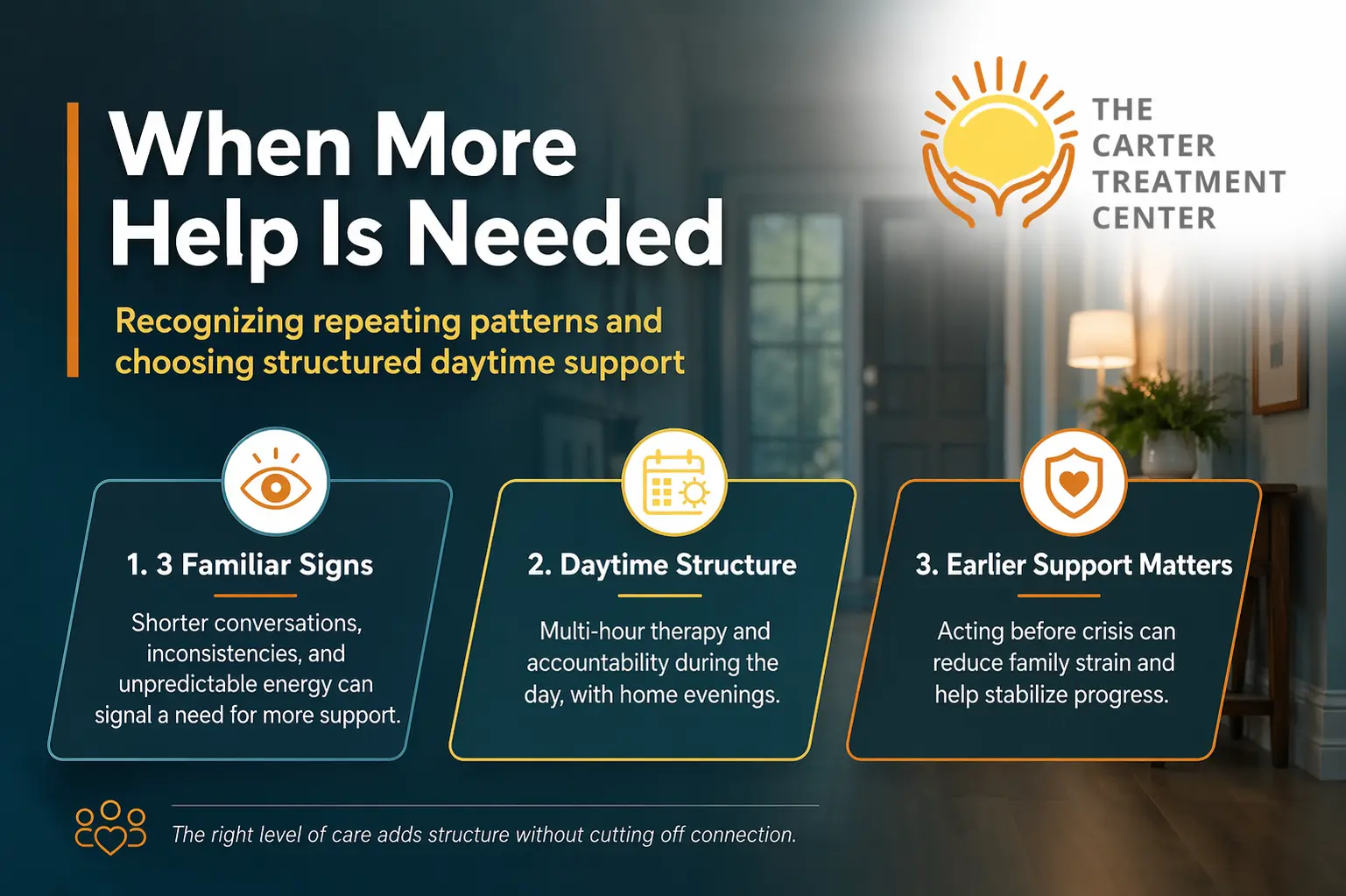
- Conversations getting shorter or more defensive
- Small inconsistencies that don’t quite add up
- A change in energy—either too flat or too unpredictable
And then comes the thought that lands heavier than anything else:
“We’ve been here before.”
That recognition doesn’t mean things are already out of control.
But it does mean your instincts are picking up on something real.
Why Parents Often Wait Longer the Second Time
There’s a quiet hope that this time will correct itself.
That maybe it’s just stress. A phase. A rough patch.
And part of that hesitation comes from love.
You don’t want to overreact. You don’t want to push too hard.
But there’s another truth underneath that:
You also don’t want to go through everything it takes to intervene again.
That’s human.
Still, waiting often comes at a cost—especially when patterns start repeating.
The Space Between “Managing at Home” and Full Removal
Most parents feel stuck between two extremes.
Either:
- Keep trying to manage things at home
or - Consider full-time, live-in care
But there’s a middle space that often gets overlooked—and it exists for moments exactly like this.
It’s structured daytime support.
Care that happens consistently during the day, while your child still returns home at night.
If you’re trying to understand what that looks like in real life, exploring a partial hospitalization program early can give you clarity before things escalate further.
Because the decision isn’t just about more care.
It’s about the right level of care.
When Love Turns Into Constant Monitoring
There’s a shift that happens slowly.
At first, you’re supporting. Checking in. Staying aware.
Then, without realizing it, you’re:
- Watching for signs
- Replaying conversations
- Trying to anticipate what might happen next
Your role starts to feel less like a parent… and more like a full-time safety system.
That’s exhausting.
And it’s often one of the clearest indicators that more structured support could help—not just your child, but you.
What Structured Daytime Support Actually Provides
This level of care isn’t about taking your child away from you.
It’s about building a stronger framework around them.
Through day treatment for addiction, your child receives consistent, multi-hour support several days a week. That means they’re not left to navigate difficult moments alone between appointments.
Instead, they have:
- Daily therapeutic structure
- Real-time guidance when things feel overwhelming
- Accountability that doesn’t rely entirely on family dynamics
It changes the rhythm of their week—and often, the direction of their progress.
Why Home Alone Can’t Always Carry the Weight
Even in loving, supportive homes, there are limits.
Not because you’re doing anything wrong—but because recovery requires more than presence.
It requires:
- Clinical structure
- Peer connection
- Consistency that doesn’t depend on mood or motivation
When those elements are missing, even the best intentions can fall short.
That’s not failure.
That’s a signal.
The Emotional Reality Parents Rarely Say Out Loud
You’re scared.
Not just of what’s happening now—but of what might happen if nothing changes.
You might be thinking:
- What if this gets worse?
- What if I miss the moment to act?
- What if I push too hard and lose them?
That tension—between acting and holding back—is one of the hardest parts of this experience.
But here’s something important:
Doing nothing is still a decision.
And often, it’s the one that allows patterns to deepen.
Acting Earlier Doesn’t Mean Overreacting
Many parents wait for a breaking point.
Something undeniable. Something that forces action.
But intervention doesn’t have to come from crisis.
In fact, acting earlier often leads to better outcomes.
Think of it like steering a car slightly off course.
It’s easier to correct early than to recover after a crash.
Choosing structured care now can stabilize things before they spiral further.
Staying Connected While Increasing Support
One of the biggest fears parents carry is this:
“If I bring in more help, will I lose connection with my child?”
But structured daytime care is designed to preserve that connection.
Your child still comes home.
They’re still part of your daily life.
The difference is—they’re supported in a way that doesn’t rely entirely on you.
For many families, this actually reduces tension and rebuilds trust over time.
If you’re looking into options, exploring support in metro atlanta can help you understand what consistent, accessible care looks like in your area.
In places like Alpharetta, Georgia, families often begin this process earlier—before things reach a breaking point—because they recognize the value of steady, structured intervention. Many parents find that having a middle-ground option makes the decision feel less extreme and more manageable.
You Don’t Have to Carry This Alone Anymore
There’s a quiet belief many parents hold:
“If I just do enough, love enough, watch closely enough… I can fix this.”
But recovery isn’t something one person can hold together alone.
Not even a parent.
Letting others step in doesn’t mean stepping back.
It means widening the circle of support around your child.
And around you.
A Moment of Honest Reflection
If you pause for a second and ask yourself:
“Can we keep going like this for another month?”
Your answer matters.
Not the hopeful answer.
The honest one.
Because that’s often where clarity begins.
FAQs Parents Ask When They’re at This Point
How do I know this isn’t just a temporary phase?
It could be—but repeated patterns are worth paying attention to. If you’re seeing familiar signs from the past, early support can prevent deeper setbacks.
Will this level of care feel too intense for them?
It’s designed to meet people where they are. For many, it feels like a structured reset—not an overwhelming step.
Can my child still live at home during this?
Yes. That’s one of the defining features. They receive support during the day and return home in the evenings.
What if they resist going?
Resistance is common. It doesn’t mean they don’t need help. Often, consistency and structure reduce resistance over time.
Am I overreacting by considering this now?
If you’re noticing patterns and feeling concerned, you’re responding—not overreacting. Early action is often the most protective step.
Will this damage our relationship?
In many cases, it improves it. Removing some of the pressure from the parent-child dynamic allows space for healthier communication.
What role do I play if they’re in structured care?
You remain essential. But instead of being the only source of support, you become part of a broader, more sustainable system.
Ready to Take the Next Step?
You don’t have to keep navigating this on your own.
Call (404) 689-9980 to learn more about our Partial Hospitalization Program in Metro Atlanta.