


It doesn’t usually look the way people expect.
Relapse after 90 days isn’t always loud or chaotic. Sometimes it’s quiet. Subtle. Almost easy to justify—until it isn’t.
And then you’re left sitting with it.
Not just what happened… but what it means.
If you’re here, thinking about stepping back into something like a structured daytime care option, you’re probably carrying more than the relapse itself.
You’re carrying the story that came with it.
I Didn’t Think It Would Happen Like That
I remember telling myself I was okay.
Not in a convincing way—more like a quiet negotiation.
“I’ve got this.”
“I know what I’m doing.”
After 90 days, you start to feel steady again. Not perfect, but grounded. And that feeling can trick you into thinking you’re beyond slipping.
Until one day, you’re not.
And it doesn’t feel like a collapse. It feels like a slow drift you didn’t notice until you were already in it.
That’s what makes it so disorienting.
The Part That Hurts Isn’t Just the Relapse
It’s what comes after.
The replaying.
The self-talk.
The quiet, heavy thought: “I knew better.”
That’s what hits hardest.
Because now it’s not just about what happened—it’s about what you think it says about you.
That you didn’t learn enough.
That you didn’t want it badly enough.
That maybe you’re just… not someone who can hold onto this.
But that story isn’t the truth. It’s just the loudest voice in the room right now.
Why Going Back Feels So Much Heavier This Time
The first time you stepped into support, there was uncertainty.
This time, there’s awareness.
You know what it takes. You know the effort, the honesty, the discomfort.
And that makes going back feel harder—not easier.
It can feel like admitting something you don’t want to admit.
Like saying, “I need help again.”
But needing support again doesn’t erase the fact that it helped before.
If anything, it proves that it works—you just need it right now.
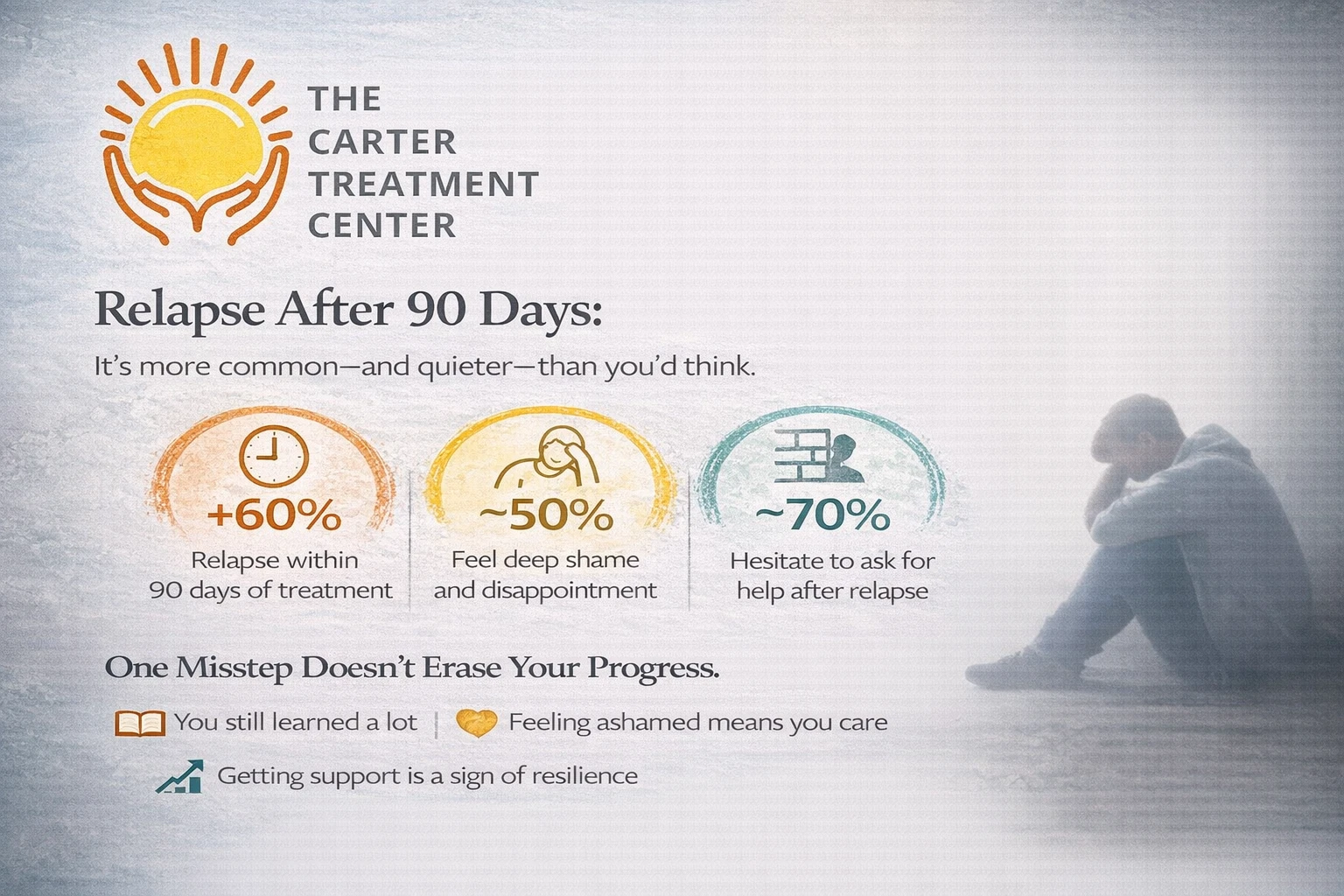
This Isn’t Starting Over — It Just Feels Like It
Relapse has a way of convincing you that everything you built is gone.
Like those 90 days don’t count anymore.
But they do.
You don’t lose what you learned. You don’t lose the awareness you gained. You don’t lose the version of yourself you got to meet during that time.
That version of you still exists.
You’re not at the beginning.
You’re somewhere in the middle—with more insight than you had before.
The Difference Between Doing It Alone and Being Supported
After I slipped, I told myself I could fix it quietly.
Tighten things up. Get back on track. No one needed to know.
But trying to rebuild in isolation felt heavier than before.
Because now there was pressure. Expectations. Fear of failing again.
What changed things wasn’t going back to something extreme.
It was finding a level of support that met me where I was.
Structured daytime care didn’t pull me out of my life—it stepped into it with me.
It gave me:
- Consistency when my motivation was shaky
- Space to be honest without feeling judged
- Structure that didn’t feel suffocating
And slowly, that steadiness started to return.
You’re Allowed to Come Back Without Explaining Everything
There’s a quiet fear a lot of people don’t talk about:
“What will they think of me?”
Like walking back into support means admitting failure out loud.
But here’s what I’ve seen—and lived:
People don’t judge you for coming back.
They respect it.
Because coming back after relapse takes something real. It takes honesty. It takes courage. It takes choosing yourself again, even when it’s uncomfortable.
You don’t have to have the perfect explanation.
You just have to show up.
A Story That Might Sound Familiar
Someone I met during treatment had almost the exact same timeline.
Around three months in, things started feeling easier. Less urgent. Less fragile.
He told himself he could handle it.
At first, it seemed like he could.
Then slowly, things slipped.
Not all at once. Just enough to start feeling off again.
When he came back, he didn’t walk in confident. He walked in frustrated. Quiet. A little guarded.
But something shifted for him—not immediately, but over time.
He stopped trying to prove he could do it alone.
He started focusing on what he actually needed.
And that made all the difference.
Not because he was perfect.
Because he was honest.
What Actually Changes the Second Time Around
The second time isn’t the same as the first.
You notice things faster.
You recognize patterns sooner.
You catch thoughts you used to miss.
And maybe most importantly—you understand the cost of ignoring those things.
That awareness isn’t a weakness.
It’s an advantage.
If you let it guide you instead of shame you.
Finding Support That Doesn’t Feel Like a Reset
One of the biggest mental blocks is the idea that going back means resetting everything.
But it doesn’t have to.
There are options that meet you in the middle—where you don’t have to leave your life behind, but you also don’t have to carry everything on your own.
If you’re looking for something that feels grounded and accessible, there are ways to find support in places like Alpharetta, Georgia that allow you to rebuild without disappearing from your life.
Having options like these available can make that next step feel even more realistic—less like a disruption, more like a continuation.
You’re not going backward.
You’re adjusting your path.
The Thought That Keeps People Stuck
“I should be able to do this on my own.”
That thought sounds strong.
But most of the time, it’s just isolating.
Because recovery was never meant to be a solo process.
And trying to force it into one only makes it harder.
You don’t have to prove anything by doing this alone.
You just have to give yourself a real chance at getting steady again.
FAQ: What Comes Up After a Relapse Like This
Did I lose all my progress?
No. Progress doesn’t disappear—it stays with you, even if it feels buried right now.
Why does this feel worse than before I started recovery?
Because you’ve experienced something different now. You know what it feels like to be clear, and losing that contrast can hit harder.
Do I have to go back to the same level of care as before?
Not necessarily. Many people find that a different level of support fits better after a relapse.
What if I don’t trust myself anymore?
That’s normal. Trust isn’t instant—it’s rebuilt through small, consistent actions over time.
Is it worth trying again if I might relapse again?
Avoiding support doesn’t reduce the risk—it usually increases it. Trying again gives you a better foundation.
What if I feel embarrassed going back?
That feeling is common—but it fades quickly once you’re in a space where people understand.
How do I take the first step without overthinking it?
Keep it simple. Reach out. Ask a question. You don’t need a full plan to begin.
You Didn’t Ruin This — You’re Still In It
I know it feels like you messed it up.
Like you had something good and let it slip through your hands.
But that’s not the full picture.
You had something real—and that means you can have it again.
Not in the exact same way.
Maybe in a stronger, more honest way.
Because now you know more. You’ve seen more. You’ve felt the difference.
And that matters.
More than the relapse ever could.
Call (404) 689-9980 or visit our partial hospitalization program in Metro Atlanta to learn more.