


Most people who contact our program do not begin the conversation by saying:
“My life is falling apart.”
Usually, it sounds more like this:
“I’m still functioning, but…”
“I don’t know if this is serious enough.”
“I think I might need more support.”
“I’m exhausted.”
“I can’t shut my brain off anymore.”
“I’m drinking more than I used to.”
“I’m still handling everything, but it’s getting harder.”
That last sentence matters more than people realize.
Because many high-functioning people wait until their lives become completely unmanageable before they believe they’ve earned the right to ask for help. By then, they’re often carrying months—or years—of hidden burnout, anxiety, isolation, substance use, and emotional exhaustion.
Programs like multi-day weekly treatment are often designed for the exact people who insist they “should” still be able to handle everything alone.
High-Functioning Struggles Are Easy to Hide
One of the hardest things about high-functioning addiction or mental health issues is that success can camouflage suffering incredibly well.
People keep showing up.
They keep producing.
They keep answering emails.
They keep parenting, leading meetings, making deadlines, paying bills, and smiling through conversations.
Meanwhile, internally, many feel like they’re slowly disappearing.
That disconnect can become dangerous because the outside world often rewards high-functioning people for pushing through pain. Friends compliment their work ethic. Coworkers admire how much they juggle. Family members assume they’re doing okay because they’re still “holding it together.”
But functioning and healing are not the same thing.
Some people are functioning entirely on:
- Anxiety
- Adrenaline
- Weed
- Alcohol
- Emotional shutdown
- Caffeine
- Constant distraction
- Perfectionism
- Survival mode
At a certain point, life starts feeling less like living and more like maintaining a performance nobody else realizes is exhausting you.
The People Who Reach Out Usually Wait Longer Than They Needed To
This is something we see often.
By the time many people finally search phrases like evening outpatient rehab near me, they’ve already spent a long time privately debating whether their struggles “count.”
Because high-functioning people are often skilled at minimizing themselves.
They tell themselves:
- “It’s not that bad.”
- “Other people need help more than I do.”
- “I’m still going to work.”
- “I’m not drinking all day.”
- “I can stop whenever I want.”
- “I just need to get through this stressful season.”
But eventually, the cracks become harder to ignore.
Sleep gets worse.
Anxiety gets louder.
Relationships feel more distant.
The substance use stops feeling recreational and starts feeling necessary.
You begin structuring your emotional survival around when you can finally drink, smoke, numb out, or shut your brain off.
That’s usually the point where people realize:
“I’m technically functioning, but I’m not okay.”
Most High-Functioning People Are Not Looking to Escape Their Lives
They’re trying to save them.
That difference matters.
A lot of people fear treatment because they imagine it as stepping away from reality entirely. They worry about work, family, responsibilities, reputation, privacy, and losing control over their routines.
But many people entering outpatient care are deeply invested in protecting the lives they’ve built.
They want to:
- Stay employed
- Repair relationships
- Feel emotionally present again
- Stop depending on substances to regulate stress
- Sleep normally
- Think clearly
- Stop feeling emotionally trapped inside their own routines
They’re not trying to quit life.
They’re trying to stop quietly drowning inside it.
And honestly, many people reach out only after years of silently convincing themselves they should be able to manage alone.
High Achievement Can Become Emotional Armor
This is something many people don’t recognize right away.
Achievement can sometimes become a coping mechanism itself.
The busier people stay, the less space there is to feel what’s underneath:
- Anxiety
- Depression
- Trauma
- Loneliness
- Burnout
- Shame
- Emotional emptiness
For high-functioning individuals, substances often become part of a carefully balanced system:
Work hard.
Push through stress.
Numb at night.
Repeat tomorrow.
At first, it can seem manageable.
Then gradually, the recovery window shrinks. You stop fully resetting emotionally between stressful days. Your nervous system stays activated constantly. You become exhausted in a way sleep alone no longer fixes.
Many people quietly reach a point where substances are no longer about enjoyment. They’re about maintenance.
That realization can feel terrifying.
But it can also become the beginning of honesty.
The Spiral Usually Starts Before Anyone Else Notices
One reason high-functioning struggles become so dangerous is because people get very good at hiding them.
Most individuals do not suddenly collapse overnight.
Usually, there are quieter warning signs first:
- Drinking or smoking more frequently to decompress
- Increasing irritability or emotional numbness
- Pulling away from people emotionally
- Trouble sleeping without substances
- Constant mental exhaustion
- Panic that spikes during quiet moments
- Feeling disconnected from your own life
- Losing interest in things that once mattered
- Secretly wondering whether weekly therapy is enough anymore
But because nothing catastrophic has happened externally yet, people often keep pushing forward.
That’s the trap.
Sometimes people wait for a dramatic rock bottom before allowing themselves support. But emotional suffering does not become more legitimate only after public collapse.
In fact, early intervention is often what protects the parts of life people care about most.
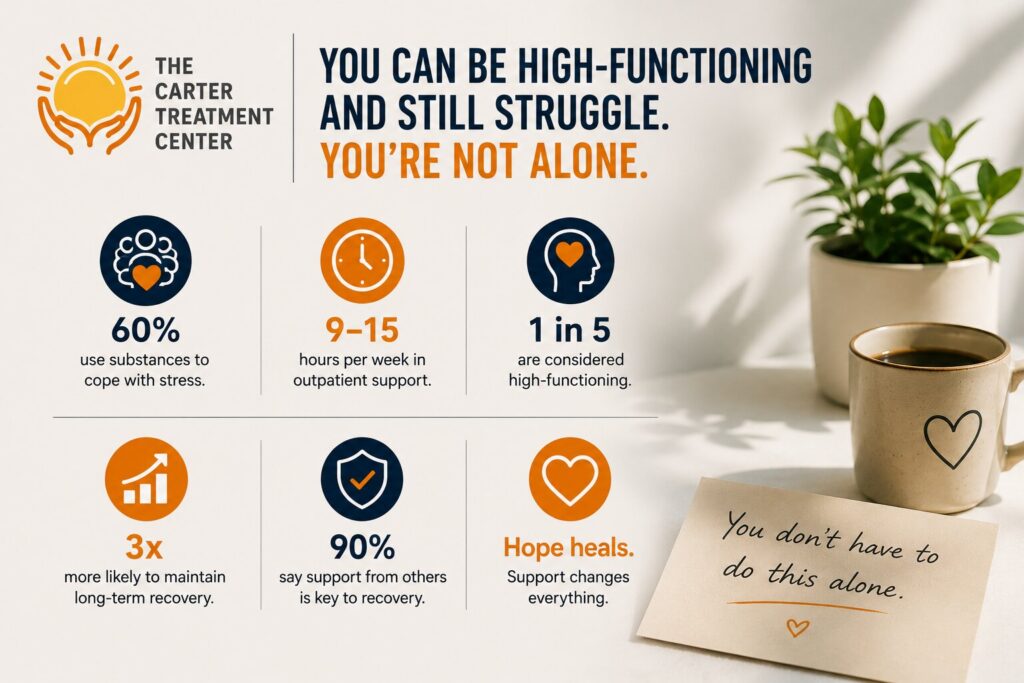
Outpatient Support Often Fits the Reality of High-Functioning Life
One reason outpatient care can feel more approachable for many people is because it acknowledges reality.
Not everyone can—or needs to—completely disappear from their responsibilities immediately.
Many people benefit from support that allows them to:
- Continue working
- Stay connected to family
- Maintain routines
- Build recovery skills in real-world environments
- Receive consistent accountability and therapy multiple times a week
For people who feel stuck between “I’m fine” and “I’m falling apart,” that middle ground can matter deeply.
Especially because many high-functioning individuals are used to carrying everything alone. Consistent support creates interruption. It gives people somewhere to process stress honestly instead of silently absorbing it until they emotionally collapse.
Sometimes structure becomes the thing that finally allows people to exhale.
The Goal Is Not to Shame You for How You’ve Been Coping
This part matters.
A lot of people entering treatment feel deeply ashamed of how dependent they’ve become on substances or unhealthy coping patterns. But most coping behaviors start for understandable reasons.
People are trying to:
- Calm anxiety
- Escape emotional pain
- Slow racing thoughts
- Feel connected socially
- Sleep
- Manage pressure
- Function through burnout
Substances work temporarily. That’s why people return to them.
The problem is that over time, the relief often becomes expensive:
Emotionally.
Physically.
Relationally.
And eventually, many people realize they are organizing their lives around avoiding discomfort instead of actually healing it.
That realization is painful. But it’s also incredibly important.
Because honesty creates options.
Denial usually creates deeper isolation.
You Do Not Need a Dramatic Breakdown Before You Deserve Help
This may be the biggest misconception high-functioning people carry.
You do not need:
- A DUI
- Job loss
- Hospitalization
- Public humiliation
- Relationship collapse
- Complete rock bottom
before you are allowed to seek support.
Many people entering treatment are simply exhausted.
Exhausted from overperforming.
Exhausted from masking anxiety.
Exhausted from self-medicating stress.
Exhausted from pretending everything feels manageable because life still “looks successful” from the outside.
And honestly? That exhaustion matters.
Sometimes people reach a point where they realize:
“I don’t want to keep surviving my life this way.”
That realization deserves attention before everything falls apart—not after.
The First Call Is Usually Harder Than Treatment Itself
Many high-functioning individuals spend months debating whether to reach out.
Not because they don’t know something’s wrong.
Because asking for help threatens the identity they’ve built around self-sufficiency.
But needing support does not erase your capability.
It does not erase your intelligence.
It does not erase your success.
If anything, many people who finally seek treatment have spent years carrying emotional weight nobody around them fully understood.
And eventually, even strong people need somewhere safe to put the weight down.
FAQ About Outpatient Treatment for High-Functioning Adults
Can someone still “look successful” and need treatment?
Absolutely. Many high-functioning individuals maintain careers, relationships, and responsibilities while privately struggling with substance use, anxiety, depression, or burnout.
What if I’m still able to work and function?
Functioning externally does not mean you feel healthy internally. Many people seek support because they are emotionally exhausted even though life still appears stable on the surface.
Is outpatient treatment only for severe addiction?
No. Many people enter outpatient care before reaching a major crisis. Support can help individuals address unhealthy coping patterns, emotional overwhelm, or escalating substance use earlier.
What if I’m worried treatment will disrupt my life?
Outpatient programs are often designed to provide support while allowing people to continue managing work, family, and other responsibilities.
Why do high-functioning people delay asking for help?
Many minimize their struggles because they compare themselves to stereotypes of addiction or crisis. Shame and perfectionism also make it harder to admit they need support.
Can anxiety, burnout, and substance use all feed each other?
Yes. Many people use substances to cope with stress, anxiety, emotional pressure, or exhaustion. Over time, those patterns can intensify mental health struggles rather than relieve them.
What if I’m not sure my problem is “bad enough”?
You do not need to hit rock bottom before seeking support. If your coping habits are affecting your emotional well-being, relationships, peace of mind, or ability to feel present in your life, that matters.
If you’re looking for compassionate treatment options in metro Atlanta, you do not have to wait until your life completely unravels before asking for help.
Call (404) 689-9980 or visit our intensive outpatient program services to learn more about our intensive outpatient program services in Alpharetta, GA.