


For years, I thought outpatient treatment belonged to people whose lives looked obviously broken.
People losing jobs.
People getting DUIs.
People waking up in hospitals.
People whose families had stopped speaking to them.
People who couldn’t hide their pain anymore.
I wasn’t any of those people.
I still worked full-time.
Still answered emails.
Still showed up to birthdays and meetings and dinners.
Still paid my bills on time.
Still laughed at the right moments.
From the outside, my life looked functional enough that even I believed my own performance most days.
That’s what made it dangerous.
Because when your life still technically “works,” it becomes incredibly easy to convince yourself you don’t deserve support yet.
I remember sitting alone late one night searching things like multi-day weekly treatment while simultaneously arguing with myself about whether I was overreacting.
Part of me knew something was wrong.
Another part kept saying:
“You’re not bad enough.”
“You still have control.”
“Other people need this more than you do.”
I believed those thoughts for a long time.
Long enough that exhaustion stopped feeling temporary and started feeling like my identity.
I Thought Successful People Were Supposed to Handle Everything Alone
That belief almost kept me stuck permanently.
I thought emotionally strong people pushed through stress quietly.
I thought responsible adults learned how to cope privately.
I thought asking for help meant I had somehow failed at being capable.
So instead of reaching out, I adapted.
I became incredibly good at functioning while overwhelmed.
I learned how to:
- Smile while emotionally numb
- Stay productive while barely sleeping
- Show up socially while feeling disconnected from everyone around me
- Drink “normally” enough that nobody questioned it
- Keep moving even when my nervous system felt permanently overloaded
That’s the thing about high-functioning struggles.
They rarely announce themselves dramatically at first.
They settle into your life slowly. Quietly. Like water rising one inch at a time in a room you’re still trying to live inside.
The Alcohol Wasn’t About Fun Anymore
I think this was one of the hardest truths for me to admit.
At some point, drinking stopped feeling recreational and started feeling medicinal.
Not in a glamorous way.
Not in a “party” way.
More in a:
“I need my brain to slow down for one hour” kind of way.
At first, alcohol helped me decompress after stressful days.
Then it became how I emotionally transitioned out of work mode at all.
Then eventually, I noticed I was structuring my evenings around relief.
That realization scared me more than I wanted to admit.
Because from the outside, nothing looked catastrophic yet.
I was still high-functioning.
Still responsible.
Still showing up.
But internally, my nervous system felt like a smoke alarm that never fully shut off.
And honestly? Living that way becomes exhausting in a way people around you often cannot see.
I Kept Comparing Myself to People Who “Had It Worse”
A lot of high-functioning people do this.
We compare our internal suffering to someone else’s visible collapse and decide we haven’t earned support yet.
I told myself:
- “I’m not drinking in the morning.”
- “I’ve never lost a job.”
- “I’m not missing responsibilities.”
- “I’m not as bad as other people.”
But eventually I realized something important:
Pain does not become legitimate only after public disaster.
A person can be deeply overwhelmed long before their life visibly falls apart.
And honestly, by the time I started searching things related to outpatient rehab schedule options, I was already emotionally exhausted from trying to negotiate with myself every day.
I just hadn’t fully admitted it yet.
The Most Dangerous Part Was How “Normal” It Started Feeling
Survival mode is sneaky because eventually your body adapts to it.
You stop noticing:
- The constant anxiety
- The racing thoughts
- The emotional numbness
- The dependence on substances to relax
- The exhaustion
- The irritability
- The isolation
Not because those things disappear.
Because they become familiar.
That happened to me slowly.
At first, I thought I was just stressed.
Then I thought I was burned out.
Then I thought maybe adulthood simply felt this heavy for everyone.
Meanwhile, my life kept shrinking emotionally.
I stopped fully enjoying things.
Stopped feeling emotionally present.
Stopped being honest about how overwhelmed I actually felt.
Everything became about maintaining functionality.
Like keeping a cracked dam standing together with duct tape and pure adrenaline.
I Was Looking for Relief Long Before I Was Looking for Treatment
This distinction matters.
Most high-functioning people are not initially searching for treatment because they believe they “need rehab.”
Usually, they’re searching because they want relief.
Relief from:
- Anxiety
- Emotional exhaustion
- Overthinking
- Insomnia
- Constant stress
- The mental obsession around drinking
- The pressure of pretending everything feels manageable
That’s where I was emotionally.
I didn’t initially want to change my whole life.
I just wanted my brain to stop feeling like it was running a marathon every day.
But eventually I had to admit something uncomfortable:
The coping methods I depended on were no longer helping me recover from stress. They were helping me avoid stress temporarily while making my emotional health worse long-term.
That realization hurt.
But it also created honesty.
And honesty changes things.
The Schedule Was Actually What Made Treatment Feel Possible
Before getting help, I assumed outpatient support would completely disrupt my life.
Instead, the structure became one of the first things that made me feel emotionally safer.
Because when your life has quietly become built around stress, avoidance, substances, and emotional survival, routine matters more than you realize.
An outpatient rehab schedule gave me something I had lost without noticing:
- Consistency
- Accountability
- Space to process emotions honestly
- Support multiple times a week
- Interruption from isolation
- A routine not centered around survival
And honestly, structure felt less restrictive than the chaos I had been living inside privately for years.
That surprised me.
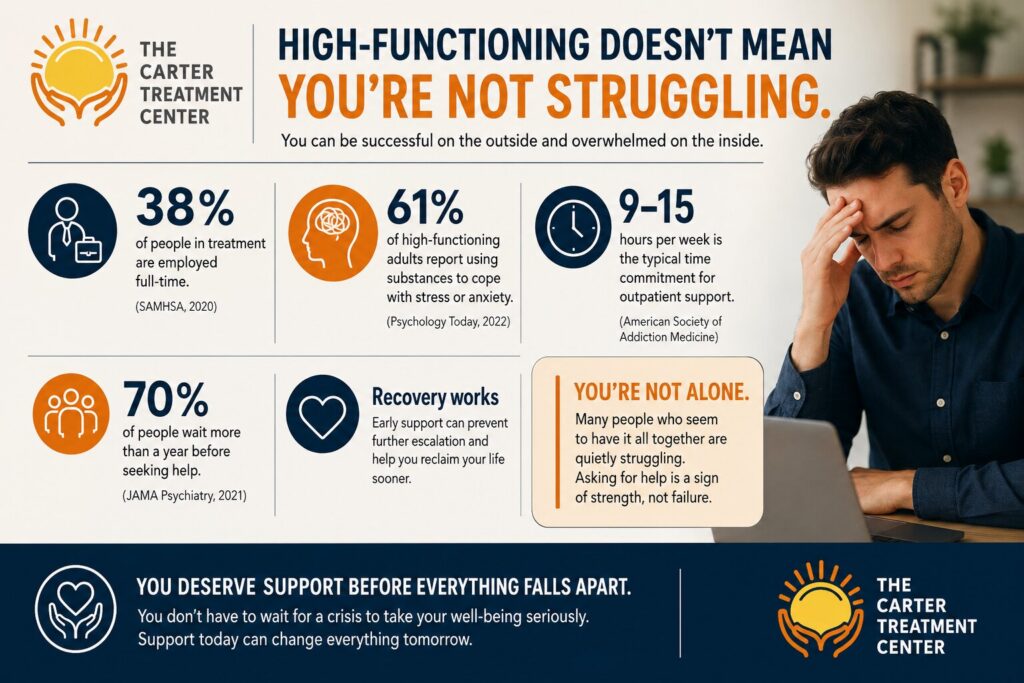
Being Around Other High-Functioning People Changed Everything
I expected treatment to feel emotionally exposing in the worst possible way.
Instead, it was one of the first places where I stopped feeling completely alone.
There were other people there who looked successful too.
People with careers.
People with families.
People who still “had it together” externally.
And almost all of them had believed the exact same thing I did:
“I’m not bad enough for this.”
That realization hit hard.
Because addiction, burnout, anxiety, and emotional exhaustion do not always look dramatic from the outside. Sometimes they look like people quietly surviving while slowly disconnecting from themselves internally.
That kind of suffering often gets missed because society rewards productivity far more than emotional honesty.
But privately, many high-functioning people are carrying more than anyone realizes.
I Realized I Wasn’t Weak—Just Completely Burned Out
This emotional shift took time.
For years, I treated myself like a machine that simply needed:
- More discipline
- Better routines
- More willpower
- Better self-control
But eventually, my body stopped cooperating with that strategy.
I wasn’t weak.
I was overloaded.
My nervous system had been operating under chronic stress for so long that substances became part of how I regulated emotions, rest, and relief.
And honestly, many people around me had no idea how bad things felt internally because I had become very skilled at appearing functional.
That’s one reason high-functioning individuals often wait too long to ask for help.
They become trapped inside the identity of “the capable one.”
Until eventually, they’re exhausted from carrying it alone.
Treatment Didn’t Take My Life Away From Me
This fear kept me stuck for a long time.
I thought treatment meant losing freedom.
Losing independence.
Losing normal life.
Instead, I slowly realized something different:
My untreated stress and substance use were already taking my life away from me emotionally.
Treatment didn’t remove me from my life.
It helped reconnect me to it.
Not instantly.
Not perfectly.
But honestly.
I started sleeping better.
Feeling emotionally present again.
Having conversations without mentally checking out.
Experiencing moments of calm that weren’t chemically created.
Small things.
But deeply important things.
I Wish I Had Asked for Help Before I Was So Exhausted
I think about this often now.
Not because I regret treatment.
Because I regret how long I believed I had to suffer privately before I deserved support.
I waited for:
- Collapse
- Certainty
- Permission
- Proof that things were “bad enough”
Meanwhile, my life kept becoming emotionally smaller.
The truth is that many high-functioning people wait far too long because they are terrified of losing the image of competence they’ve built around themselves.
But needing help does not erase your intelligence.
Your success.
Your discipline.
Your capability.
It simply means you are human.
And humans are not designed to carry overwhelming stress alone forever.
If You’re Quietly Exhausted, That Matters
You do not need:
- A dramatic rock bottom
- Public consequences
- Complete collapse
- Someone else’s permission
before asking for support.
If substances have become more about survival than enjoyment…
If your nervous system feels constantly overloaded…
If you are exhausted from pretending everything is manageable…
If your life still “works” externally but feels unbearable internally…
That matters.
Even if nobody else fully sees it yet.
Especially then.
FAQ About Outpatient Treatment for High-Functioning Adults
Can someone still work full-time and need treatment?
Absolutely. Many high-functioning people maintain careers, relationships, and responsibilities while privately struggling with substance use, anxiety, burnout, or emotional exhaustion.
What if I don’t think my problem is serious enough?
You do not need to hit rock bottom before seeking support. If your coping habits are affecting your emotional health, peace of mind, relationships, or quality of life, that matters.
Will outpatient treatment completely disrupt my schedule?
Many outpatient programs are designed to fit around work and daily responsibilities. Structured support can often exist alongside real life instead of removing you from it completely.
Why do high-functioning people delay treatment?
Many compare themselves to stereotypes of addiction or crisis and convince themselves they should be able to manage alone. Shame and perfectionism also play major roles.
What if I’m using alcohol mainly to cope with stress?
That’s very common. Many people begin using substances to calm anxiety, decompress, sleep, or emotionally regulate chronic stress. Over time, those patterns can become difficult to manage independently.
Is it normal to feel emotionally exhausted even if life looks successful?
Yes. External success does not automatically create emotional stability or peace. Many high-functioning individuals feel deeply burned out while appearing fine externally.
Can outpatient treatment help before things completely fall apart?
Yes. In many cases, earlier support helps people stabilize before substance use, burnout, anxiety, or emotional isolation become more severe.
If you’re looking for compassionate support in metro Atlanta, you do not have to wait until everything collapses before asking for help.
Call (404) 689-9980 or visit our intensive outpatient program services to learn more about our intensive outpatient program services in Alpharetta, GA.