


“I’m fine.”
It rolls off the tongue automatically. At work. At dinner. In front of your kids. In response to “You look tired” or “Everything okay?”
Because it has to.
You’ve built a whole life that depends on you keeping it together. So you say the words, even when they feel like a lie.
But eventually, something cracks. Not publicly—yet. Internally. In the quiet moments. When the wine doesn’t even help you sleep anymore. When you wake up with anxiety that doesn’t have a name. When the thing you’re afraid of isn’t failure—it’s being found out.
If any of that lands a little too hard, you’re not alone. And you’re not broken.
It might just be time to stop managing and start healing.
Our intensive outpatient program is designed for people exactly like you: high-functioning, exhausted, and ready to feel like yourself again.
The “Successful” Addict: It Doesn’t Look the Way You Think
You’ve got a job. Maybe a good one. You show up. You meet deadlines. You pay the mortgage.
You also drink every night. Or pop pills in the morning. Or go from Adderall to Ambien in a 24-hour cycle. You might even run marathons or host PTA meetings in between.
This is what high-functioning addiction looks like.
You’re not crashing cars. You’re not missing work. That’s what makes it so hard to admit there’s a problem.
But high-functioning doesn’t mean healthy. It means you’ve become an expert at hiding the cost.
And the truth? You shouldn’t have to hide anymore.
What an Intensive Outpatient Program Actually Offers
You don’t need a hospital stay. You don’t want to explain a 30-day absence.
That’s exactly where intensive outpatient programs (IOPs) come in.
An IOP is real treatment, without having to disappear from your life. You attend multiple group and individual sessions a week—mornings or evenings—around your work, parenting, or personal schedule.
You stay at home. You keep your job. You live your life.
But you finally stop living it alone.
Here’s what a typical week might include:
- 3 to 5 group therapy sessions (day or evening track)
- Weekly individual therapy
- Psychoeducation workshops on triggers, coping skills, relapse prevention
- Optional family or couples counseling
- Case management and accountability check-ins
It’s not a shortcut. It’s structure—with flexibility. And for someone used to control, that structure can feel like a life raft.
What “I’m Fine” Is Hiding (And Why That’s Not Weakness)
If you’re still saying “I’m fine” out loud, but falling apart quietly, you’re not weak. You’re practiced.
You’ve learned to function through:
- Silent panic attacks during client calls
- Needing a substance to sleep, eat, or relax
- Hyper-productivity that masks internal chaos
- Fear of being exposed as someone who doesn’t have it all together
- Moments of blankness where nothing feels real or fulfilling
An IOP peels back the armor. Not all at once—but enough to show you what else might be possible. It’s not about breaking down. It’s about slowing down—so the rest of your life doesn’t have to.
How High-Functioning People Heal Differently
High-functioning addiction comes with unique challenges. You don’t just need coping tools—you need space to admit that you’re tired of performing. That you’re scared to stop because you don’t know who you are without the pressure, without the edge, without the bottle or pill that keeps you going.
In group, you’ll sit next to others like you: professionals, parents, entrepreneurs, caregivers.
And one day, someone will say something like:
“I built a whole identity around being the strong one. But it turns out, strength without support is just self-abandonment.”
And just like that, you won’t feel as alone.
This Isn’t Rock Bottom. And That’s the Point.
You don’t have to hit bottom to deserve help.
In fact, many people in our IOP program start treatment before things blow up. That’s called wisdom, not weakness.
The goal of an intensive outpatient program isn’t to rescue you from a dramatic collapse. It’s to catch you before that point.
To give you a space where it’s okay to say:
“I’m not fine. And I don’t want to keep pretending.”
You’re Not the Exception—You’re Just Tired
It’s easy to believe your situation is unique. That because you’re high-functioning, treatment isn’t “for you.”
But here’s the truth:
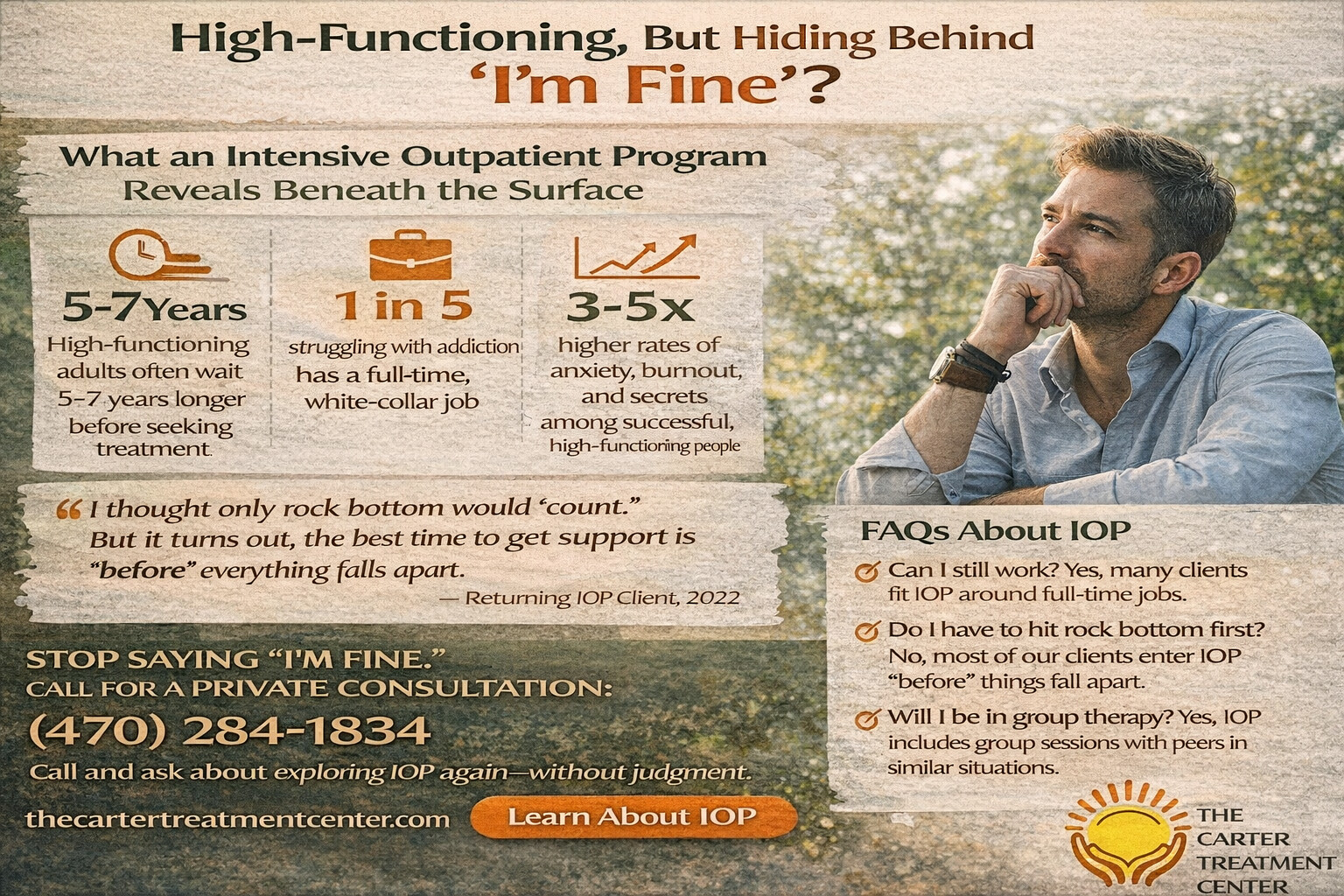
📊 1 in 5 people who meet the criteria for substance use disorder are employed full-time.
📊 High-functioning individuals often wait 5–7 years longer to seek treatment than those with more visible struggles.
That delay isn’t about strength. It’s about shame.
An IOP breaks through the shame by saying: you’re allowed to heal before things get worse.
If you’re in metro Atlanta and looking for discreet, flexible support, our treatment options in metro Atlanta offer care that fits your real life—not some Hollywood version of rock bottom.
FAQ: Intensive Outpatient Program for High-Functioning Adults
What makes IOP different from regular therapy?
Regular therapy is usually once a week. IOP offers multiple sessions per week, structured around deeper group and individual work. It’s designed to address more serious or persistent issues—like substance use or burnout—without requiring inpatient treatment.
Will I be in a group with people very different from me?
Group members often come from different walks of life—but many are professionals, parents, and high-functioning individuals hiding similar struggles. Most clients are surprised by how relatable the stories are, no matter the surface-level differences.
Can I keep working during IOP?
Yes. IOP is built to fit into your life. Many programs offer morning, afternoon, or evening sessions so you can continue working or managing responsibilities while still receiving consistent support.
Do I have to identify as an “addict” to join?
Not at all. Many clients in IOP are still questioning their relationship with substances. You don’t have to fit a label to receive help. The only requirement is a willingness to be honest—and open to change.
What if I’m scared to let people down?
That fear is real. But IOP isn’t about removing your responsibilities—it’s about helping you carry them differently. In most cases, clients become more present, more connected, and more stable at work and home after entering treatment.
Ready to Stop Pretending?
You’ve carried the weight of “I’m fine” long enough.
You don’t have to collapse to get support. You just have to take a breath and decide: I’m ready to do this differently.
Call (470) 284-1834 or visit to learn more about our intensive outpatient program services in Jefferson, GA.