


Have you ever stared at a task you genuinely wanted to complete—but couldn’t make yourself begin?
Maybe you’ve watched hours pass while thinking about sending one email.
Perhaps you’ve sat in front of a growing to-do list, fully aware of everything that needs to be done, yet unable to take the first step.
From the outside, it may look like procrastination.
Inside, it feels completely different.
You are not relaxing.
You are not choosing to avoid the task.
You feel stuck.
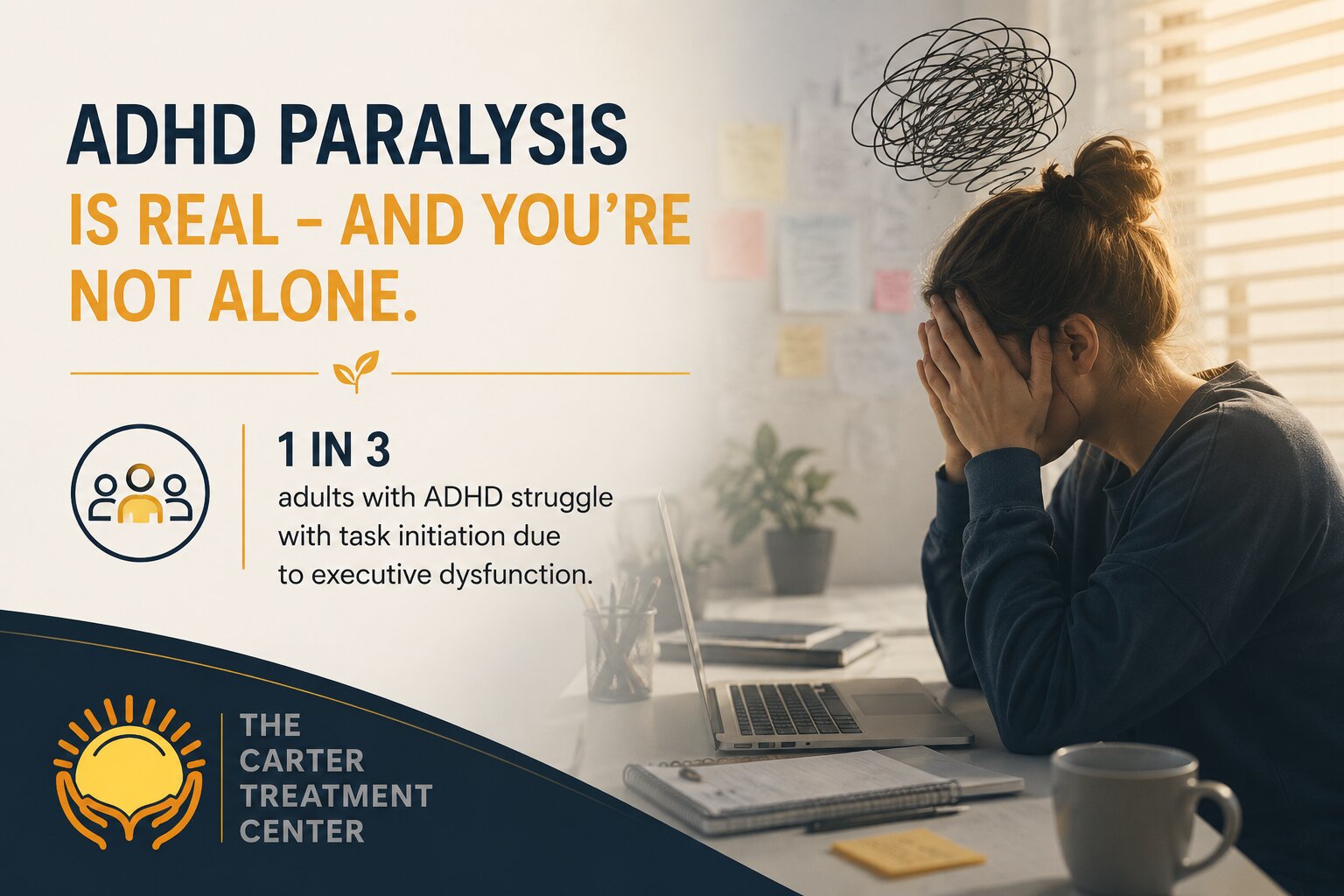
For many people living with ADHD, this experience is known as ADHD paralysis.
Although it is not an official medical diagnosis, the term is widely used to describe moments when executive functioning becomes so overwhelmed that initiating, organizing, deciding, or completing tasks feels almost impossible.
The encouraging news is that this experience is not a character flaw or a lack of motivation. It is a well-recognized manifestation of executive dysfunction, and with the right support, many people learn practical strategies to reduce its impact. At The Carter Treatment Center, we help adults throughout North Atlanta—including Alpharetta, Cumming, and Jefferson—better understand attention-related challenges and access compassionate ADHD treatment through comprehensive outpatient mental health care.
What ADHD Paralysis Is
ADHD paralysis describes a state where the brain feels “stuck” despite a genuine desire to take action.
Someone experiencing ADHD paralysis may:
- Know exactly what needs to be done.
- Understand why the task is important.
- Feel anxious about delaying it.
- Want to begin.
- Still be unable to get started.
This experience can affect work, school, household responsibilities, relationships, and personal goals.
Unlike simple procrastination, ADHD paralysis is closely connected to executive functioning—the mental processes responsible for planning, initiating tasks, organizing information, regulating attention, and managing emotions.
Many people describe it as feeling as though the brain has temporarily stopped responding.
Task Freeze
You know what the first step is.
You simply cannot begin.
Even relatively simple activities like paying a bill, folding laundry, or making a phone call may feel impossible.
Decision Freeze
Instead of completing a task, your brain becomes overwhelmed by choices.
Questions begin multiplying.
Where should I start?
Which project matters most?
What if I choose the wrong option?
Eventually, no decision feels possible.
Mental Freeze
Sometimes the problem is not one specific task.
The brain simply feels overloaded.
Thoughts race.
Attention shifts constantly.
Nothing feels organized enough to act upon.
Why the ADHD Brain Gets Stuck
The experience of ADHD paralysis is largely connected to executive dysfunction.
Executive functions help the brain:
- Initiate action
- Plan ahead
- Organize information
- Prioritize tasks
- Manage working memory
- Shift attention
- Regulate emotions
- Monitor progress
In ADHD, these processes often require far more effort than many people realize.
Difficulty Starting Tasks
Task initiation is one of the most common executive function challenges.
The brain may understand what needs to happen but struggle to activate the process of actually beginning.
This is why someone may spend hours thinking about a task without taking action.
Working Memory Overload
Working memory allows us to temporarily hold and organize information while completing activities.
When working memory becomes overwhelmed, even straightforward tasks may suddenly feel confusing or disorganized.
People often report:
- Forgetting the next step
- Losing track of priorities
- Feeling mentally scattered
- Constantly switching between tasks
Emotional Regulation Challenges
ADHD affects more than attention.
Many individuals also experience heightened emotional responses.
Fear of failure.
Perfectionism.
Overwhelm.
Frustration.
Anxiety.
These emotions increase the mental effort required to begin a task.
Sometimes the emotional discomfort becomes stronger than the motivation to complete the activity.
Too Much Information at Once
Large projects require breaking complex work into smaller pieces.
For people with ADHD, the brain may perceive the entire project all at once.
Instead of seeing:
“Write the introduction.”
It sees:
“The entire report.”
That enormous mental picture can make beginning feel overwhelming.
The Types of ADHD Paralysis
Although everyone’s experience is unique, ADHD paralysis often falls into several common patterns.
Task Paralysis
This is the form many people recognize first.
You know exactly what needs to happen.
You may even have plenty of time.
Yet you remain unable to begin.
Examples include:
- Answering emails
- Cleaning the house
- Starting homework
- Paying bills
- Scheduling appointments
Choice Paralysis
Having too many options can overwhelm executive functioning.
Questions continue multiplying:
Which assignment first?
Which grocery store?
Which career path?
Which email should I answer?
Instead of choosing, the brain freezes.
Mental Paralysis
Some days everything feels equally urgent.
Thoughts become crowded.
Concentration becomes difficult.
Even deciding where to look first feels exhausting.
Mental paralysis often leaves people feeling mentally “locked up.”
Practical Ways to Move Through ADHD Paralysis
Although ADHD paralysis can feel overwhelming, small changes often make tasks more manageable.
Recovery rarely comes from trying harder.
Instead, it comes from reducing the demands placed on executive functioning.
Make the First Step Extremely Small
Instead of focusing on completing an entire project, identify the smallest possible starting point.
For example:
Instead of:
“Clean the kitchen.”
Try:
- Wash one plate.
- Throw away one piece of trash.
- Put away three items.
Momentum often builds after beginning.
Reduce Visual Overload
Large task lists can increase overwhelm.
Many people find it helpful to focus on only one next step rather than reviewing every responsibility at once.
Use External Supports
Executive functioning improves when the brain does not have to remember everything internally.
Helpful tools include:
- Calendars
- Timers
- Digital reminders
- Written checklists
- Visual planners
These systems reduce cognitive load.
Work With Time Instead of Against It
Some people find success using structured work periods, such as working for 15–25 minutes followed by a short break.
Short time blocks can feel less intimidating than open-ended work sessions.
Be Aware of Perfectionism
Many people experiencing ADHD paralysis are not avoiding work because they do not care.
They care deeply.
Sometimes they care so much that fear of making mistakes prevents them from starting.
Accepting “good enough” can make beginning much easier than waiting for the perfect moment.
Practice Self-Compassion
Negative self-talk often worsens executive dysfunction.
Instead of thinking:
“I’m lazy.”
Try reminding yourself:
“My brain is overwhelmed right now. I need support, not shame.”
This shift may sound simple, but reducing self-criticism can improve motivation over time.
When to Seek Support
Occasional difficulty starting tasks happens to everyone.
Professional support may be helpful if ADHD paralysis regularly interferes with:
- Work performance
- Academic success
- Relationships
- Household responsibilities
- Financial management
- Emotional well-being
A comprehensive evaluation can help determine whether ADHD, anxiety, depression, another mental health condition, or a combination of factors is contributing to these challenges.
At The Carter Treatment Center, outpatient mental health care focuses on understanding the unique ways ADHD affects each individual. Treatment may include therapy, medication management when appropriate, practical executive functioning strategies, education, and support designed to reduce daily struggles while improving overall quality of life.
The goal is not simply to increase productivity.
It is to help people spend less time feeling stuck and more time engaging in the activities that matter most to them.
Final Thoughts
ADHD paralysis can make even simple responsibilities feel overwhelming, leaving people frustrated and questioning why they cannot accomplish tasks they genuinely want to complete.
The reality is that this experience is not laziness or a lack of effort. It reflects the executive functioning challenges that are common in ADHD, and those challenges are both real and treatable.
Understanding how ADHD affects task initiation, decision-making, and emotional regulation can replace years of self-blame with practical strategies and hope. With the right combination of therapy, medication management when appropriate, supportive routines, and personalized coping skills, many people learn to move through moments of paralysis more effectively.
At The Carter Treatment Center, we provide compassionate outpatient mental health services for adults throughout Alpharetta, Cumming, Jefferson, and the greater North Atlanta area. Call us today at 404.689.9980 to learn more about our treatment programs and take the first step toward a healthier, more fulfilling future. If executive functioning challenges are making daily life feel harder than it should, professional support can help you better understand your brain and develop tools that make everyday tasks more manageable.
Frequently Asked Questions
What is ADHD paralysis?
ADHD paralysis is a term used to describe moments when executive dysfunction makes it extremely difficult to start, organize, decide on, or complete tasks. Although it is not an official medical diagnosis, it is a common experience reported by many people with ADHD.
Why can’t I start tasks with ADHD?
Difficulty starting tasks is often related to executive dysfunction rather than a lack of motivation. Challenges with task initiation, working memory, emotional regulation, overwhelm, and perfectionism can all make it difficult for the ADHD brain to transition from thinking about a task to actually beginning it.
How do you overcome ADHD paralysis?
Managing ADHD paralysis often involves breaking tasks into very small steps, using external supports such as calendars and reminders, reducing distractions, practicing self-compassion, and seeking professional support when executive functioning challenges significantly affect daily life. Therapy, ADHD coaching, and medication management may also be helpful depending on the individual’s needs.