


In my work as a clinician, I often meet people who start the conversation the same way.
“I’m already in therapy.”
They say it carefully. Sometimes defensively. Like they need to prove they’re trying.
And they are.
Many high-functioning individuals begin with weekly therapy because it feels manageable. It fits into a busy life filled with meetings, responsibilities, and family commitments. It allows them to work on themselves without disrupting the life they’ve built.
But eventually, some people come back and say something else.
“I think I might need more than this.”
That moment usually opens the door to discussing options like a multi-day weekly treatment program.
Not because therapy failed.
But because the problem grew bigger than one hour a week could hold.
The People Who Usually Ask This Question
The people wondering about this step rarely fit the stereotype of addiction.
They’re often highly capable people.
Professionals with demanding careers.
Parents juggling family life.
Leaders responsible for teams or businesses.
From the outside, their lives look stable.
They’re productive. Reliable. Successful.
But privately, many are dealing with something different.
They feel exhausted from managing stress.
They notice their relationship with alcohol or substances changing.
They realize their coping strategies are starting to run their life instead of supporting it.
High-functioning individuals are often very good at holding things together.
The problem is that holding everything together all the time can become incredibly tiring.
When One Hour a Week Starts to Feel Too Small
Weekly therapy can be powerful.
It gives people space to reflect, process emotions, and gain insight into patterns that shape their lives.
But sometimes the challenges someone is facing don’t stay neatly contained between sessions.
A person might walk into therapy carrying an entire week of stress, conflict, and self-doubt.
They talk through it.
They gain perspective.
They leave feeling hopeful.
But by Thursday or Friday, life has filled the space again.
Work pressure builds.
Family responsibilities increase.
Old habits return.
The next session feels far away.
For some people, that gap becomes the place where struggles quietly grow.
Insight Alone Doesn’t Always Create Change
One of the most important things people learn during therapy is insight.
Insight helps someone understand why they behave a certain way.
Why stress leads to drinking.
Why certain emotions feel overwhelming.
Why old habits keep resurfacing.
Understanding these patterns is incredibly valuable.
But understanding something doesn’t always mean it changes right away.
Real behavioral change often requires repetition.
It requires practicing new skills, facing real-life challenges with support nearby, and having multiple opportunities during the week to reflect and reset.
That’s where a more structured recovery environment can help.
The Power of Consistent Support
One of the biggest differences people notice when they move beyond weekly therapy is consistency.
Instead of talking through challenges once every seven days, they have multiple points of support during the week.
That changes the rhythm of recovery.
When something stressful happens, they don’t have to hold it alone until the next appointment.
They can process it sooner.
They can learn from it while the experience is still fresh.
And they can practice different responses in real time rather than in hindsight.
That kind of consistent support can accelerate growth in ways that once-weekly conversations sometimes cannot.
The Role of Community in Healing
Another difference people often notice is the presence of peers.
Weekly therapy is usually a private conversation between a therapist and a client.
Structured treatment environments often include group discussions as well.
For high-functioning individuals, this can be one of the most surprising and powerful parts of the experience.
Many people arrive assuming they are the only person living a double life.
Successful on the outside.
Struggling quietly inside.
Hearing others describe similar experiences often removes a layer of isolation and shame.
It reminds people they are not uniquely broken.
They are human.
And they are not alone.
Keeping Your Life While Getting Support
One of the biggest fears people have when they consider additional treatment is losing the life they’ve built.
They worry about stepping away from work.
They worry about responsibilities at home.
They worry about the impact on their reputation or relationships.
The good news is that many recovery options are designed specifically for people who cannot simply disappear from their lives.
Participants continue living at home.
They maintain employment.
They remain present for their families.
But their week now includes consistent recovery support woven into that routine.
That structure can make healing possible without dismantling the life someone is trying to protect.
The Quiet Moment of Realization
For most people, the decision to seek more support doesn’t come from a dramatic crisis.
It comes from a quiet moment of honesty.
Maybe they realize they keep having the same conversation in therapy every week.
Maybe attempts to cut back haven’t lasted.
Maybe the exhaustion of managing everything alone has simply grown too heavy.
Those moments are not signs of failure.
They are signs of awareness.
And awareness is often the beginning of meaningful change.
Choosing the Level of Support That Fits
There is no single correct path to recovery.
For some people, weekly therapy is exactly what they need.
For others, adding more structured support for a period of time creates the momentum that therapy alone couldn’t generate.
The goal isn’t to replace therapy.
It’s to match the level of support to the challenge someone is facing.
Sometimes the most compassionate step someone can take for themselves is simply acknowledging that they don’t have to carry everything alone.
Frequently Asked Questions
Is weekly therapy helpful for substance use challenges?
Yes. Weekly therapy can provide important space to explore patterns, emotions, and behaviors related to substance use. For some people, it offers meaningful support and insight.
Why might someone need more support than therapy alone?
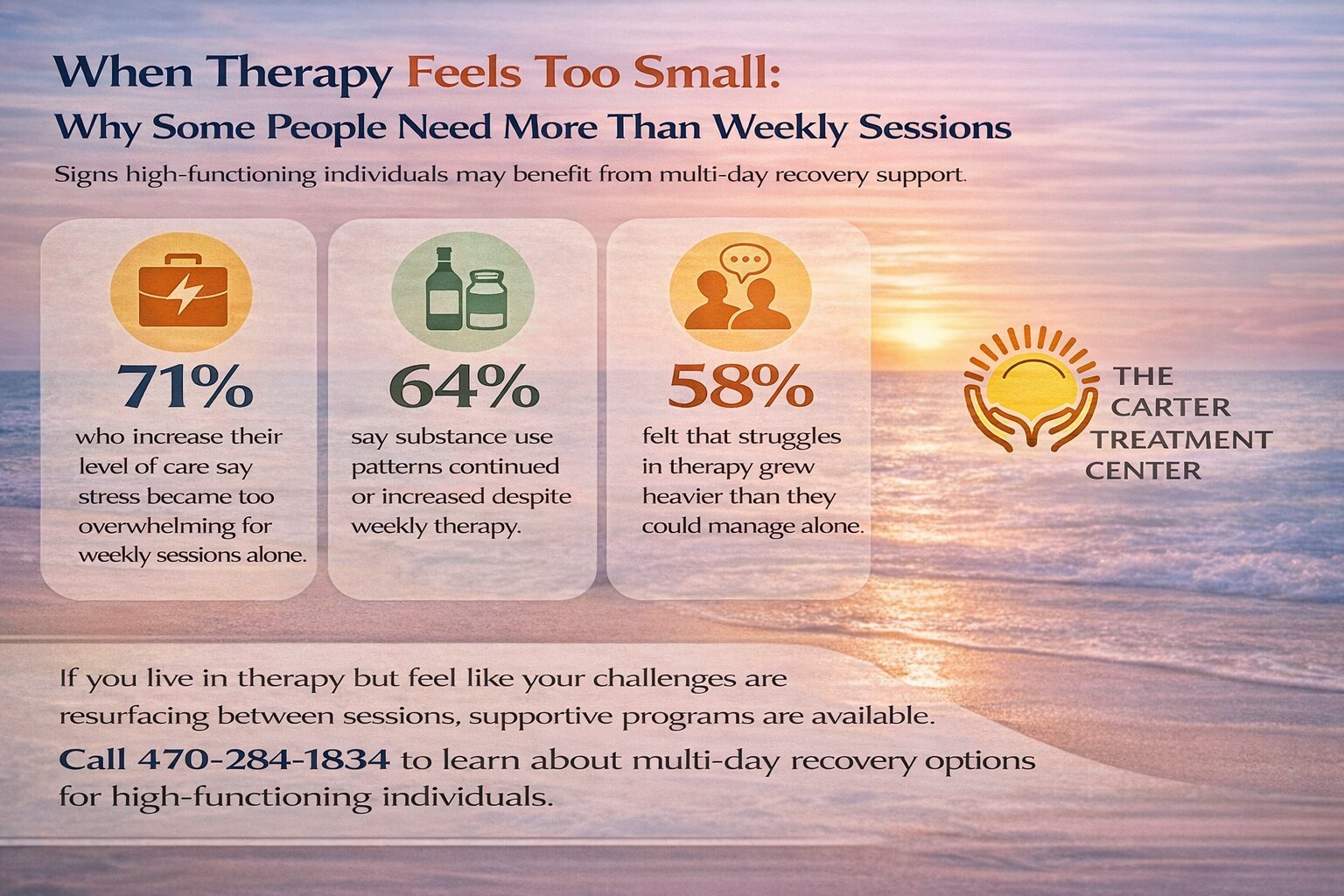
Some individuals find that their substance use patterns continue despite therapy. In those cases, more consistent support during the week can help reinforce healthier habits and coping strategies.
Do people have to stop working to receive structured recovery support?
Not always. Many programs are designed to allow participants to maintain employment and family responsibilities while attending treatment sessions.
Can high-functioning professionals benefit from structured treatment?
Yes. Many individuals with demanding careers find that additional structure helps them address patterns that have become difficult to manage alone.
Is group support necessary for recovery?
Group environments are not required for everyone, but many people find that hearing others share similar struggles reduces isolation and increases motivation.
What if I’m unsure whether I need more support?
Uncertainty is very common. Talking with a professional about your current challenges can help clarify what level of care might be most beneficial.
Can someone return to weekly therapy after more structured treatment?
Yes. Many people transition back to weekly therapy after completing a period of structured recovery support.
If you’re currently in therapy but feel like the struggle keeps resurfacing between sessions, it may be time to explore additional support.
For individuals seeking compassionate support in metro atlanta, recovery programs exist that allow people to strengthen their healing while continuing to live their everyday lives. For individuals seeking ongoing recovery care in Alpharetta, GA or Jefferson, GA, compassionate support is available.
Call 470-284-1834 or visit our multi-day weekly treatment options to learn more about our intensive outpatient program services.